
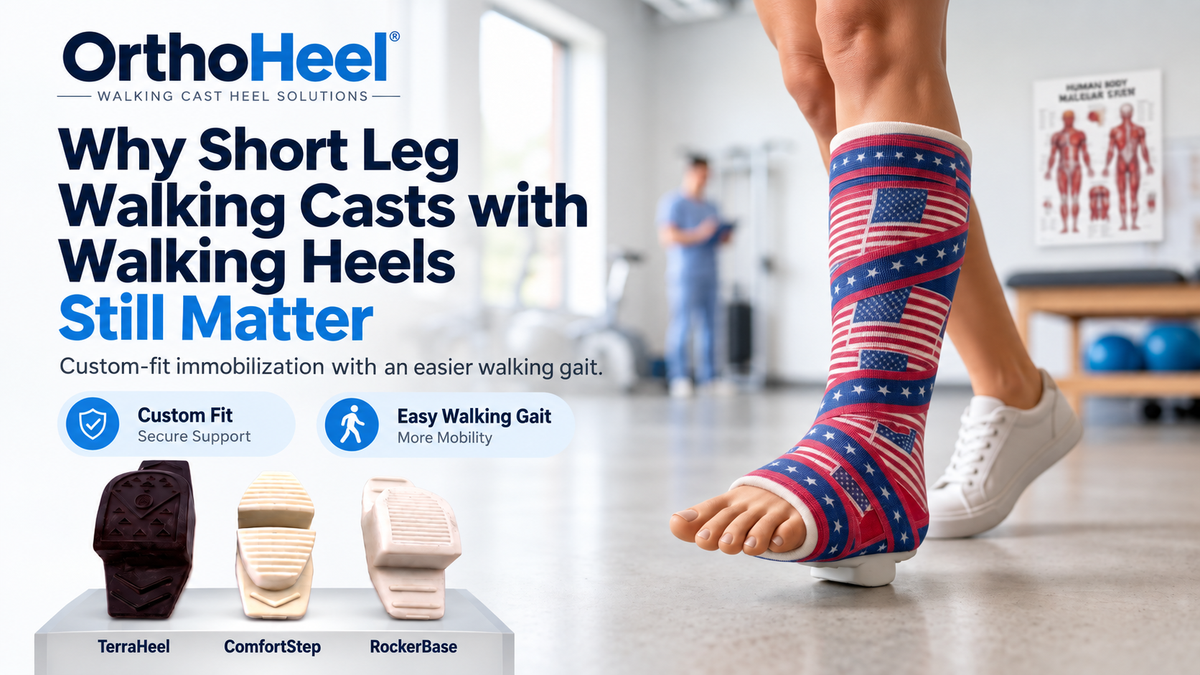
For decades, the short leg walking cast with a walking heel has been a familiar part of orthopedic care. A properly applied short leg cast provides custom-molded immobilization around the lower leg, ankle, and foot. When a treating clinician determines that weight bearing is appropriate, a walking cast heel can provide a durable walking surface while allowing the patient to remain in the clinician-applied cast.
Today, removable CAM walker boots are widely used—and for good reason. They are convenient, adjustable, removable for hygiene, and appropriate for many injuries. But the growth of removable walking boots has not made the traditional short leg walking cast obsolete.
For some patients and some treatment plans, continuous custom-molded immobilization still matters.
Quick Answer
BSN Medical / Essity has discontinued its familiar Adult, Child, Pedestal, and Cushion Tread walking cast heel line. The discontinuation creates a need for new walking heel options, but it does not eliminate the clinical role of the short leg walking cast. OrthoTape developed OrthoHeel walking cast heels to provide currently available alternatives for professional cast application.
BSN Medical and Essity Walking Cast Heels Have Been Discontinued
Many orthopedic departments, cast technicians, hospitals, clinics, and medical suppliers will recognize the traditional BSN walking cast heel family.
The former lineup included the Adult Walking Heel, Child Walking Heel, Pedestal Walking Heel, and Cushion Tread Walking Heel.

You may also encounter searches for BSN Pedistal walking heel. “Pedistal” is a common misspelling of Pedestal and is worth recognizing when searching old purchasing records or trying to identify a legacy product.
The historical BSN/Essity orthopedic catalog described these walking heels as specialized synthetic-rubber components with a deep tread and a center slot for secure application. The catalog identified the four designs under manufacturer reference numbers 4183-130, 4183-132, 4183-133, and 4183-135.[4]
| Discontinued BSN style | BSN catalog ref. | Legacy SKU reference | OrthoHeel option to consider |
|---|---|---|---|
| Adult Walking Heel | 4183-130 | 7444900 | TerraHeel or ComfortStep |
| Child Walking Heel | 4183-132 | 7444901 | Confirm current pediatric sizing |
| Pedestal Walking Heel | 4183-133 | 7444902 | RockerBase |
| Cushion Tread Walking Heel | 4183-135 | 7444903 | TerraHeel or ComfortStep |
These are alternative configurations to consider, not claims that each OrthoHeel style is dimension-for-dimension identical to a discontinued BSN product. Heel selection, sizing, cast construction, and suitability for weight bearing remain clinical decisions.
Introducing OrthoHeel Walking Cast Heels
OrthoTape developed the OrthoHeel line to keep the walking cast heel available to orthopedic facilities and casting professionals who continue to use short leg walking casts.

TerraHeel
TerraHeel is the black OrthoHeel design with a rugged tread profile. It provides a durable ground-contact surface and is an option to consider for facilities previously using a traditional adult or broad-tread walking cast heel.

ComfortStep
ComfortStep is the white center-groove OrthoHeel design. Its configuration provides another option for clinicians who prefer a traditional walking cast heel with a divided center profile.

RockerBase
RockerBase uses a rocker-style profile and is the closest OrthoHeel concept to the discontinued BSN Pedestal walking heel.

View OrthoHeel Walking Cast Heels
Why Short Leg Walking Casts with Walking Heels Still Matter
The rise of removable CAM boots has sometimes created the impression that traditional walking casts are outdated.
They are not.
The Pediatric Orthopaedic Society of North America continues to identify short-leg walking casts among recognized treatment options for several pediatric foot fractures. POSNA also notes that a walking boot may be considered in place of a weight-bearing cast for appropriate fractures.[2]
That distinction matters because a walking cast and a removable boot are different tools with different characteristics.
The clinically useful question is not “Which device is always better?” It is “Which form of immobilization is appropriate for this patient, this injury, and this treatment plan?”
1. A Short Leg Cast Is Custom Molded to the Patient
One of the fundamental differences between a short leg cast and a prefabricated CAM walking boot is how the device fits the patient.
A fiberglass or plaster cast is formed directly around the patient's anatomy. The clinician or cast technician can contour the immobilization around the:
- lower leg,
- ankle,
- heel,
- arch, and
- foot.
A CAM boot approaches fit differently. It is a manufactured device offered in predetermined sizes. Straps, liners, and—in some models—adjustable air cells help adapt the device to the patient, but the anatomy still has to fit within the dimensions of the manufactured shell.
For many patients, that works very well. For others, especially very small children or patients whose anatomy falls between standard device proportions, a custom-molded cast provides a different approach to immobilization.
2. Pediatric Patients Make the Fit Question Especially Relevant
Children are not simply smaller adults.
A young child's lower leg may be short, the foot may be very small, and the relationship between calf circumference, ankle size, and foot length may not correspond neatly with the proportions of a prefabricated walking boot.
A short leg cast approaches that problem differently because the cast is molded directly around the child's anatomy.
That does not mean every pediatric patient should be placed in a cast instead of a boot. In fact, good clinical evidence supports removable boots for certain stable pediatric fractures.
What a 2025 Randomized Pediatric Trial Found
A 2025 multicenter randomized clinical trial published in JAMA Pediatrics compared a removable walking boot with circumferential casting in 129 children between 9 months and 4 years of age with radiographically visible toddler's fractures.[1]
The study found that treatment with a removable boot was noninferior to casting for pain recovery. Children in the boot group also returned to baseline activities sooner, and caregivers reported less difficulty with bathing and carrying the child.[1]
Those findings are important and demonstrate why removable boots have an appropriate role in pediatric fracture care.
The same study reported a clinically relevant but not statistically significant trend toward more skin complications in the boot group. Five children in the boot group developed stage-1 pressure sores compared with one child in the cast group. The authors noted that fit mismatch in the prefabricated boots may have allowed movement-related friction over bony prominences such as the heel.[1]
The lesson is not that casts are always better. The lesson is that fit matters.
3. Removability Is Both an Advantage and a Limitation
One of the greatest benefits of a CAM boot is obvious:
It comes off.
That can make bathing easier. The skin can be inspected. A liner can be adjusted. The treating clinician may prescribe periods of removal when appropriate.
But removability also creates a different treatment model from a cast.
A removable device depends on the device being reapplied, positioned correctly, and adjusted appropriately. A properly constructed cast remains molded around the limb until it is professionally removed or changed.
When the treatment objective includes continuous immobilization, that distinction may matter.
This can be particularly relevant for young children who repeatedly loosen or remove a device, patients who have difficulty managing straps correctly, or situations where the clinician wants the immobilization to remain in a consistent position.
In the 2025 toddler-fracture trial, 36% of children assigned to the boot had discontinued using it “most of the time” by two weeks, while 93% of the cast group continued wearing the cast through the prescribed three-week treatment period. Because the study protocol specifically permitted caregivers to remove the boot at their discretion, this should not be interpreted as proof of noncompliance. It does, however, illustrate the inherent difference between removable and non-removable immobilization.[1]
4. Weight Bearing Does Not Automatically Require Switching to a Boot
Another common assumption is that once a patient is permitted to bear weight, the patient must move from a short leg cast into a CAM boot.
That is not necessarily the case.
A walking cast heel gives a clinician another option when a short leg cast remains the preferred immobilization and weight bearing has been authorized.
The cast continues to provide the custom-molded immobilization.
The walking heel provides the dedicated ground-contact surface.

What a Walking Cast Heel Actually Is
A walking cast heel is not the anatomical heel of the patient's foot and it is not the heel of a shoe or boot.
The finished short leg cast has its own solid plantar base beneath the foot. The walking heel is positioned under that cast base, generally beneath the central plantar portion of the foot, so the walking heel—not the fiberglass cast itself—becomes the primary surface contacting the floor.
Fiberglass casting tape is incorporated through and around the walking heel's attachment area to secure the heel to the cast construct.
The result is a short leg walking cast in which the molded cast provides immobilization and the attached walking heel provides a durable walking surface.

Application should be performed by a trained healthcare professional. Heel position, attachment, cast alignment, and the patient's weight-bearing status are clinical decisions.
The American Academy of Orthopaedic Surgeons advises patients not to walk on a walking cast until their doctor says it is safe.[3]
5. A Walking Heel Can Preserve a Cast That Already Fits Well
Consider a patient whose short leg cast:
- fits well,
- maintains the position selected by the clinician,
- provides the intended immobilization, and
- is otherwise functioning exactly as intended.
If that patient later becomes eligible for weight bearing, transitioning into a removable prefabricated boot is not automatically the only option.
Depending on the diagnosis, healing stage, and treatment plan, a clinician may choose to maintain the short leg cast and use a walking heel to create a short leg walking cast.
This preserves the custom-molded cast construct while adding a purpose-built walking surface.
Short Leg Walking Cast vs. CAM Boot
The most useful comparison is not a contest over which device is universally “better.” Each approach has characteristics that may be advantageous for different patients and injuries.
| Feature | Short Leg Walking Cast | Removable CAM Boot |
|---|---|---|
| Fit | Molded directly to the patient's limb | Prefabricated sizes adjusted with liners, straps, or air cells |
| Removability | Non-removable without professional cast removal | Designed to be removable |
| Position | Position is maintained by the molded cast construct | Fit and position depend partly on correct placement and adjustment |
| Skin access | Limited until the cast is removed or changed | Easy access for inspection and hygiene when removal is permitted |
| Walking surface | A walking heel can be incorporated when weight bearing is authorized | Integrated molded sole or rocker sole |
| Pediatric fit | Cast is molded directly around the child's anatomy | Child must fit within available manufactured size ranges |
Neither column represents the correct choice for every patient. The treating healthcare professional should determine the appropriate immobilization and weight-bearing plan.
Why Short Leg Walking Casts Can Be Particularly Useful in Children
Pediatric fit is one reason the traditional short leg walking cast should not be forgotten.
A child's anatomy may not correspond neatly to the proportions of a prefabricated boot shell. A properly constructed short leg cast is instead molded directly around the child's lower leg, ankle, and foot.
And because the cast is not casually removable, maintaining the prescribed immobilization does not depend on a young child leaving a removable device alone or on repeatedly recreating the original fit.
Again, this does not mean every child should receive a cast. Removable boots are appropriate for many stable injuries and can reduce caregiver burden. The point is that the custom-fit short leg walking cast remains an important clinical option when continuous immobilization or patient-specific molded fit is desirable.
The BSN Discontinuation Should Not Mean the Disappearance of the Walking Cast Heel
For years, BSN Medical walking heels were familiar products in orthopedic cast rooms:
- Adult,
- Child,
- Pedestal, and
- Cushion Tread.
As those products disappear from the market, it would be easy to assume that the treatment concept itself is disappearing with them.
It is not.
The reasons short leg walking casts have been used for decades have not disappeared because one manufacturer discontinued a product line.
Custom molding still matters.
Consistent immobilization still matters.
Patient fit still matters.
And when a clinician chooses a weight-bearing cast, a durable walking surface still matters.
That is the gap OrthoHeel by OrthoTape was created to help fill.
OrthoHeel by OrthoTape
OrthoHeel provides three walking cast heel configurations for professional application:
- TerraHeel — black rugged-tread design
- ComfortStep — white center-groove design
- RockerBase — white rocker-profile design
Hospitals, orthopedic clinics, cast rooms, DME suppliers, and purchasing departments searching for replacements for discontinued BSN walking cast heels can compare these styles and select the appropriate option for their clinical application.
Related Orthopedic Casting Supplies
Facilities using short leg casts can also find the related casting materials needed to support a complete orthopedic casting program at OrthoTape.
- Fiberglass Casting Tape
- Cast Material Kits
- Cast Padding
- Stockinette for Casting
- Plaster Bandages
- All Orthopedic Casting Supplies
- Medical CAM Boots
Frequently Asked Questions About Walking Cast Heels
Are BSN Medical and Essity walking cast heels discontinued?
Yes. The former BSN Medical and Essity Adult, Child, Pedestal, and Cushion Tread walking cast heel line has been discontinued. OrthoHeel provides currently available walking cast heel alternatives for professional cast application.
What is a walking cast heel?
A walking cast heel is an orthopedic rubber component secured beneath the plantar surface of a short leg cast to provide a durable ground-contact surface when weight bearing has been authorized by the treating clinician. It is incorporated into the cast construct and is not the anatomical heel of the patient's foot.
Why do short leg walking casts with walking heels still matter?
A short leg walking cast can preserve custom-molded, continuous immobilization while adding a dedicated walking surface when weight bearing is clinically appropriate. This gives clinicians an option other than changing every patient to a removable prefabricated boot.
Is a short leg walking cast better than a CAM boot?
Not universally. Both are appropriate for selected injuries and patients. A removable CAM boot offers removability, adjustability, skin access, and convenience. A short leg cast provides custom-molded, non-removable immobilization. The treating clinician should select the appropriate method for the individual patient and injury.
Why can walking boot fit be challenging in some young children?
Prefabricated boots come in manufactured size ranges, while pediatric lower-leg and foot proportions vary. A custom cast is molded directly around the child's anatomy. A 2025 randomized trial of toddler's fractures reported a clinically relevant but not statistically significant trend toward more skin complications in the boot group and discussed fit mismatch and movement-related friction as a possible contributor.[1]
Can walking cast heels be used with fiberglass and plaster casts?
Yes. Walking cast heels are designed for professional incorporation into short leg fiberglass or plaster cast construction. Position, attachment, cast alignment, and suitability for weight bearing should be determined by a trained healthcare professional.
Can a patient walk immediately after a walking cast heel is applied?
No. A patient should walk on a walking cast only when the treating clinician says it is safe. The American Academy of Orthopaedic Surgeons advises patients not to walk on a walking cast until their doctor authorizes it.[3]
Which OrthoHeel style is an alternative to the discontinued BSN walking heels?
TerraHeel or ComfortStep are alternatives to consider for the former BSN Adult and Cushion Tread styles. RockerBase is the closest OrthoHeel concept to the former BSN Pedestal style. Pediatric heel sizing should be confirmed for the individual patient.
The Bottom Line
Removable walking boots have become an important part of modern orthopedic care.
But they did not make the short leg walking cast with a walking heel obsolete.
A short leg walking cast offers something fundamentally different: custom-molded, continuous immobilization combined with a dedicated walking surface when weight bearing is clinically appropriate.
That distinction can matter in adults.
It can matter in children.
And it can matter whenever fit, consistency, and maintaining a clinician-applied cast construct are treatment priorities.
BSN Medical / Essity may have discontinued its familiar Adult, Child, Pedestal, and Cushion Tread walking heels.
Short leg walking casts—and the walking cast heels that make them practical for appropriate weight-bearing patients—still have a place in orthopedic care.
That is why OrthoTape created OrthoHeel.
Shop OrthoHeel Walking Cast Heels
Professional-use and medical notice: This article is provided for general educational and product-information purposes. The appropriate type of immobilization, cast construction, walking heel selection, and timing or amount of weight bearing should be determined by the patient's treating healthcare professional. Walking cast heels should be positioned and secured by a trained medical professional.
References
- Boutin A, Colaco K, Stimec J, et al. Removable Boot vs Casting of Toddler's Fractures: A Randomized Clinical Trial. JAMA Pediatrics. 2025;179(7):713-721. DOI: 10.1001/jamapediatrics.2025.0560. View the full study .
- Pediatric Orthopaedic Society of North America. Pediatric Tarsal and Metatarsal Fractures. POSNA identifies short-leg walking casts among treatment options for selected pediatric foot fractures and notes that a walking boot may be considered instead of a weight-bearing cast in appropriate cases. View POSNA guidance .
- American Academy of Orthopaedic Surgeons. Cast Care. AAOS advises patients not to walk on a walking cast until their doctor says it is safe. View AAOS cast-care guidance .
- BSN Medical / Essity. Orthopedics Catalog — Walking Heels. Historical product documentation identifies the Adult 4183-130, Child 4183-132, Pedestal 4183-133, and Cushion Tread 4183-135 walking heels and describes the synthetic-rubber construction and center-slot application design. View historical BSN / Essity catalog .