
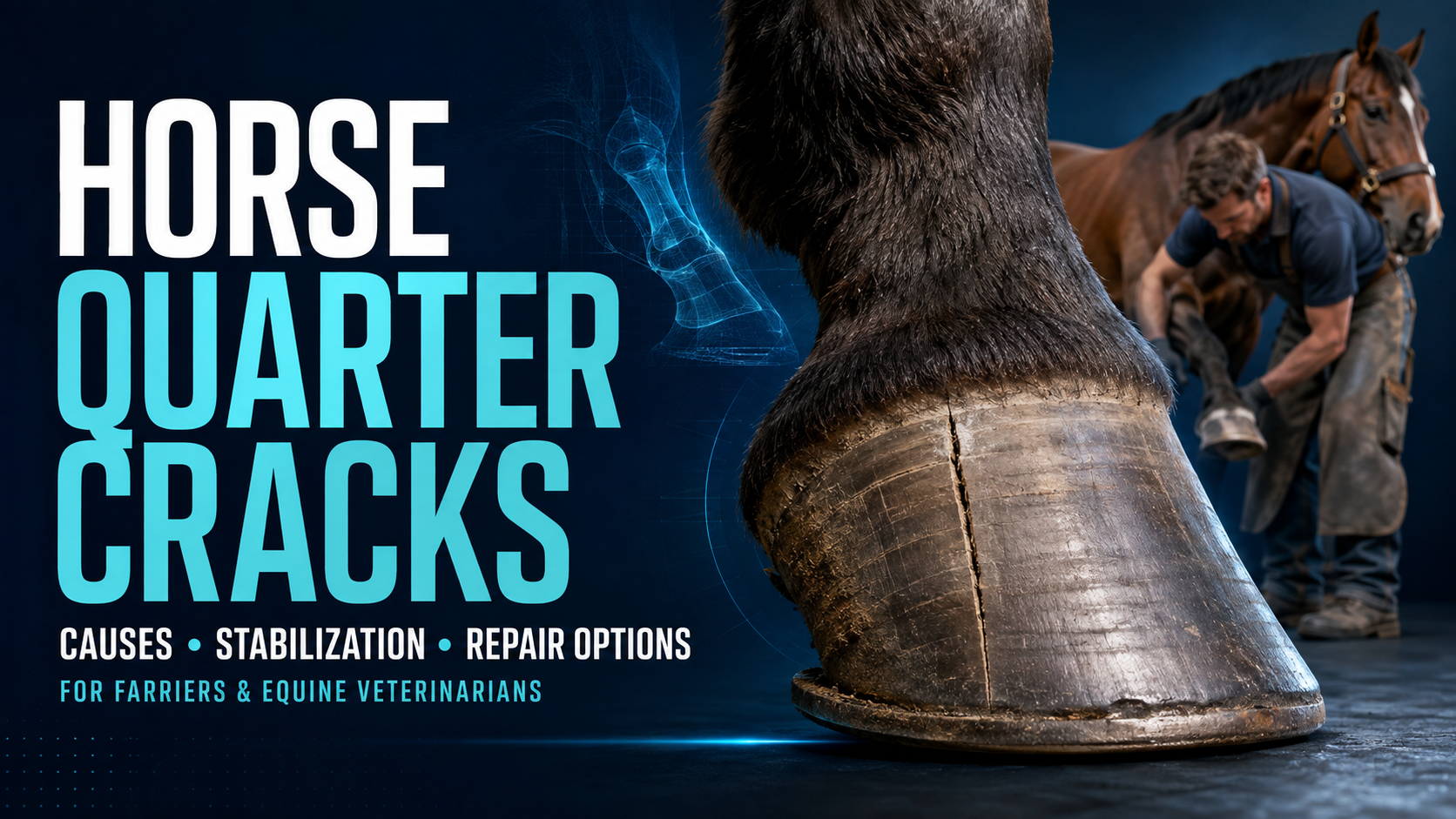
Horse Quarter Cracks: Causes, Stabilization and Repair Options
A quarter crack is not simply a line to cover. For farriers and equine veterinarians, successful management begins with understanding why the hoof wall is failing, how the affected quarter is being loaded and whether the crack is stable, infected or painful.
Direct answer: A horse quarter crack is a vertical hoof-wall defect located in the medial or lateral quarter. True full-thickness quarter cracks commonly originate at the coronary band. Management typically requires a coordinated plan to identify the cause, correct hoof mechanics, unload the damaged area, stabilize the wall when appropriate and monitor the crack as healthy horn grows distally.
What Is a Quarter Crack in a Horse?
The term quarter crack describes a vertical defect in the side of the hoof wall. Cracks differ in length, depth, origin and clinical importance. A shallow surface line may be primarily cosmetic, while a full-thickness defect can destabilize the hoof capsule, involve sensitive tissue and contribute to inflammation, infection or lameness.
A true quarter crack is commonly described as beginning at the coronary band and extending downward. This distinguishes it from many ground-surface cracks that begin distally and migrate upward. The direction and depth matter because a coronary-origin crack can affect new wall as it is formed.
Professional evaluation should answer four immediate questions:
- Does the crack move or open as the hoof loads and unloads?
- Is it superficial, partial thickness or full thickness?
- Are pain, bleeding, drainage, heat, infection or undermined horn present?
- What abnormal force, trauma or hoof disease allowed the crack to form?

What Causes Quarter Cracks in Horses?
Quarter cracks develop when the hoof wall is exposed to stress that exceeds its ability to deform and recover. In many full-thickness cases, the visible crack is the result of a deeper loading or hoof-capsule problem rather than the primary problem itself.
Uneven loading and hoof-capsule distortion
Repeated disproportionate loading can change hoof shape over time. A sheared heel—one heel bulb displaced proximally relative to the other—is frequently associated with full-thickness quarter cracks. The affected quarter may become more upright and overloaded while the opposite side flares. Movement around the displaced coronary band can then concentrate stress where the crack begins.
Conformation, trimming and shoeing
Limb conformation influences how a horse lands and loads the foot. Trimming and shoe placement can either improve or worsen those forces. Excessive hoof length, an imbalanced trim, inadequate heel support or shoe fit that does not match the hoof's mechanical needs may contribute in some horses. A crack should not automatically be blamed on one trim or one shoeing cycle; many cases are multifactorial.
Coronary-band trauma and damaged horn production
Direct trauma or a prior wound at the coronary band can disrupt horn production and create a persistent weak line. Poor-quality horn, environmental moisture changes, white line disease and other hoof pathology may further reduce structural integrity. When infection or necrotic tissue is present, it must be addressed rather than sealed beneath a repair.
Key professional principle: Stabilizing the crack without correcting the forces that created it may produce a neat-looking repair while leaving the reason for recurrence unchanged.
How to Evaluate and Plan Management for a Horse Quarter Crack
The following is a professional decision framework, not a universal treatment recipe. The veterinarian and farrier should adapt each step to the horse, the hoof, the crack and the intended activity.
- Assess the horse and hoof on a hard, level surfaceObserve stance, limb conformation, landing pattern, lameness and the hoof from the front, side, behind and solar surface. Compare heel height, coronary-band position, growth rings, wall flare and the opposite foot.
- Determine crack depth, stability and complicationsEstablish where the crack begins, how far it extends, whether its margins move under loading and whether pain, bleeding, drainage, infection, undermined horn or sensitive-tissue involvement is present.
- Identify the underlying mechanical or traumatic causeEvaluate hoof-capsule distortion, sheared heel, mediolateral loading, limb conformation, trimming and shoeing history, coronary-band trauma, horn quality and concurrent hoof disease.
- Correct hoof balance and unload the affected quarterDevelop a case-specific trimming and therapeutic-shoeing plan that reduces damaging movement and shifts load away from the compromised region while respecting sole depth and internal alignment.
- Select a stabilization methodChoose hoof casting, a bonded patch, lacing, an implant or another repair only after preparation, infection control, unloading and the required amount of hoof-capsule movement have been considered.
- Establish follow-up and growth-out monitoringRecheck stability, comfort, cast or repair integrity, shoe fit, coronary-band growth and hoof balance on a planned schedule. Modify the strategy if the crack remains active, complications appear or abnormal loading returns.
Veterinarian and Farrier Roles in Quarter-Crack Management
Quarter cracks often respond best to collaboration. The dividing line between roles varies by jurisdiction, training and case complexity, but the management plan should connect diagnosis and tissue health with hoof mechanics and practical farriery.
| Clinical Need | Veterinary Contribution | Farrier Contribution |
|---|---|---|
| Determine clinical significance | Lameness assessment; evaluation of pain, sensitive-tissue involvement, infection and other pathology | Assessment of crack movement, hoof wear, landing, hoof-capsule distortion and shoeing history |
| Understand hoof alignment | Diagnostic imaging when internal alignment, bone position or another lesion must be evaluated | External hoof mapping, trimming assessment and interpretation of weight-bearing patterns |
| Address complications | Diagnosis and treatment of infection, diseased tissue, pain or concurrent lameness | Preparation of sound wall and coordination of the mechanical repair with the treatment plan |
| Reduce destructive forces | Case-specific restrictions and rehabilitation guidance | Corrective trimming, unloading, therapeutic shoe selection and repair implementation |
| Monitor growth-out | Reassessment when lameness, infection or deeper pathology persists | Scheduled trim, shoe, cast or repair checks as hoof growth changes the mechanics |
Quarter-Crack Stabilization and Repair Options
No single repair method fits every quarter crack. The method must match the condition of the wall, the direction of movement, the horse's workload, the shoeing plan and the need to inspect or treat tissue beneath the defect.
| Option | Primary Purpose | Important Considerations |
|---|---|---|
| Corrective trimming and unloading | Reduce abnormal leverage and pressure at the affected quarter | Foundational to most plans; the correction possible at one visit is limited by sole depth, hoof anatomy and tissue condition |
| Therapeutic shoeing | Increase stability, redistribute load and reduce independent heel movement | Shoe type, fit, extensions, breakover and whether the damaged quarter bears on the shoe must be selected for the individual hoof |
| Bonded patch or composite repair | Bridge and reinforce prepared hoof wall | Requires clean, appropriately prepared horn; sealing infection or unstable diseased tissue beneath a patch can complicate management |
| Lacing, implants or mechanical fixation | Control movement across selected full-thickness defects | Technique, implant placement and crack preparation require experience and must avoid sensitive structures |
| Hoof casting | Provide circumferential external reinforcement and integrate support around the hoof capsule | Material, tension, layers, heel involvement, shoeing interface, inspection needs and removal timing must be planned before application |
When Hoof Casting May Be Considered for a Quarter Crack
A hoof cast can function as an external reinforcement around the hoof capsule. Depending on the professional plan, it may help limit unwanted wall movement, protect compromised horn or integrate with a therapeutic shoeing strategy. It can also distribute support over a broader area than a localized patch.
Hoof casting is not automatically appropriate simply because a crack is visible. Before application, the veterinarian-farrier team should decide:
- Whether the crack and surrounding horn are clean, stable and ready to cover
- Whether infection, drainage or diseased tissue requires access and treatment
- How much heel and hoof-capsule movement should be preserved or controlled
- Whether the cast will be used with a shoe, pad, plate or other offloading method
- How the cast will be inspected, maintained and removed
- What workload and environment the repair must tolerate
The cast supports the management plan; it does not replace diagnosis, hoof balancing, therapeutic farriery or treatment of infection.

Polyester vs. Fiberglass Hoof Casting Tape
Both OrthoHoof options use a water-activated polyurethane resin, but the underlying fabric changes handling and cured behavior. Selection should be made by the applying professional rather than by treating one material as universally better.
| Feature | Polyester Hoof Casting Tape | Fiberglass Hoof Casting Tape |
|---|---|---|
| Cured character | More pliable while remaining a true cast material | More rigid structural support |
| Wear behavior | Greater abrasion resistance for movement and rough terrain | Very firm but more brittle where repeated heel movement concentrates stress |
| Potential fit | Cases where conformability and tolerance of normal movement are priorities | Cases where the professional plan calls for greater rigidity and movement is more restricted |
| Selection question | How much flexibility, rigidity, abrasion resistance and heel movement does this particular repair require? | |
Shop OrthoHoof Equine Hoof Casting Tape
OrthoHoof is made for professional hoof-casting applications and is available in polyester and fiberglass formulations. Choose a 2-inch width for more precise control or a 3-inch width for broader coverage. Single rolls support trials and occasional cases; 10-roll boxes fit higher-volume farrier and veterinary use.

OrthoHoof 2-Inch — Single Roll
A narrow-width option for precise repair zones, smaller hooves and practitioners evaluating the material for an occasional case.
View 2-Inch Single Roll
OrthoHoof 2-Inch — 10-Roll Box
The precise 2-inch width in clinic and farrier-practice packaging for teams that regularly keep narrow casting material available.
View 2-Inch 10-Roll Box
OrthoHoof 3-Inch — Single Roll
Broader coverage per pass for standard hoof-wall applications, supplied as one roll for trial use, mobile kits or an occasional case.
View 3-Inch Single Roll
OrthoHoof 3-Inch — 10-Roll Box
The broad 3-inch width in high-volume packaging for equine hospitals, veterinary practices and farriers who cast hooves regularly.
View 3-Inch 10-Roll BoxMonitoring the Crack Through Growth-Out
A quarter-crack repair is not a one-visit event. As the hoof grows, the position of the defect, the cast or patch, the shoe and the loading pattern all change. Regular reassessment is needed to confirm that the repair remains stable, the horse stays comfortable and new wall emerging from the coronary band is growing in a healthier direction.
Follow-up intervals should reflect crack severity, repair method, growth rate, workload and environment. Re-evaluation should occur sooner if lameness increases, drainage or odor develops, the cast or repair shifts, the shoe loosens, the crack opens, the coronary band becomes painful or a new distortion appears.
Preventing Recurrent Quarter Cracks
Recurrence prevention is primarily mechanical and managerial. A repaired wall remains vulnerable if the horse returns to the same loading pattern that produced the defect. A prevention plan may include:
- Regular farrier intervals tailored to the horse's hoof growth and workload
- Ongoing correction or management of sheared heels and hoof-capsule distortion
- Appropriate shoe size, placement, heel support and breakover
- Monitoring of landing pattern, surface, workload and changes in limb comfort
- Prompt investigation of coronary-band injury, abscess tracts, white line disease or damaged horn
- Veterinary reassessment when the crack recurs despite apparently appropriate farriery
Frequently Asked Questions About Horse Quarter Cracks
What is a quarter crack in a horse hoof?
A quarter crack is a vertical defect in the side, or quarter, of the hoof wall. A true full-thickness quarter crack commonly begins at the coronary band and can create hoof-wall instability, inflammation, infection and lameness.
What causes quarter cracks in horses?
Quarter cracks may be associated with uneven loading, hoof-capsule distortion such as a sheared heel, limb conformation, inappropriate trimming or shoeing, coronary-band trauma, poor horn quality or disease. The cause must be identified in the individual horse because stabilizing the visible crack alone does not correct abnormal forces.
How do you treat a quarter crack in a horse?
Treatment is individualized and may include correcting hoof balance, unloading the affected quarter, therapeutic shoeing, treating infection or damaged tissue, stabilizing the hoof wall and scheduling regular follow-up. A veterinarian and farrier should select the method according to the crack's depth, stability, cause and clinical complications.
Can hoof casting help stabilize a horse quarter crack?
Hoof casting may be used by an experienced farrier or veterinarian as one method of externally reinforcing and stabilizing a compromised hoof capsule. Whether it is appropriate depends on crack depth, infection status, hoof mechanics, shoeing plan and the horse's use.
When should a veterinarian evaluate a horse quarter crack?
Veterinary evaluation is especially important when the horse is lame, the crack bleeds or drains, sensitive tissue is involved, infection is suspected, the coronary band is distorted, the crack is unstable or the problem keeps returning. Diagnostic imaging may be useful when hoof-capsule and distal-phalanx alignment need evaluation.
How long does a horse quarter crack take to grow out?
The damaged section must move down the hoof as new wall grows from the coronary band, so complete growth-out usually takes months rather than days. Timing varies with crack origin and depth, hoof growth, loading, recurrence and how successfully the underlying cause is controlled.
What is the difference between polyester and fiberglass hoof casting tape?
Polyester hoof casting tape is generally more pliable and abrasion resistant, while fiberglass tape cures into a more rigid structure. Material selection should reflect the stabilization goal, expected movement, terrain, hoof mechanics and the veterinarian-farrier plan for the individual horse.
Should I use 2-inch or 3-inch hoof casting tape for a quarter crack?
Two-inch tape provides more precise control for narrower repair zones and smaller hooves. Three-inch tape covers a broader area per pass and is commonly selected for standard hoof-wall coverage. The professional applying the cast should choose the width that permits controlled wrapping without unwanted bulk or pressure.
Professional References
- American Association of Equine Practitioners: How to Manage Hoof Wall Defects
- World Equine Veterinary Association Proceedings: Managing Hoof Wall Defects
- AAEP Care Guidelines for Equine Rescue and Retirement Facilities
- Veterinary Clinics of North America: Equine Practice — Farriery for Hoof Wall Defects
Professional-use information: This article is educational and does not replace examination, diagnosis or a case-specific treatment plan from a qualified equine veterinarian and experienced farrier. Hoof casting and crack-repair procedures require appropriate training, safety precautions and follow-up.