
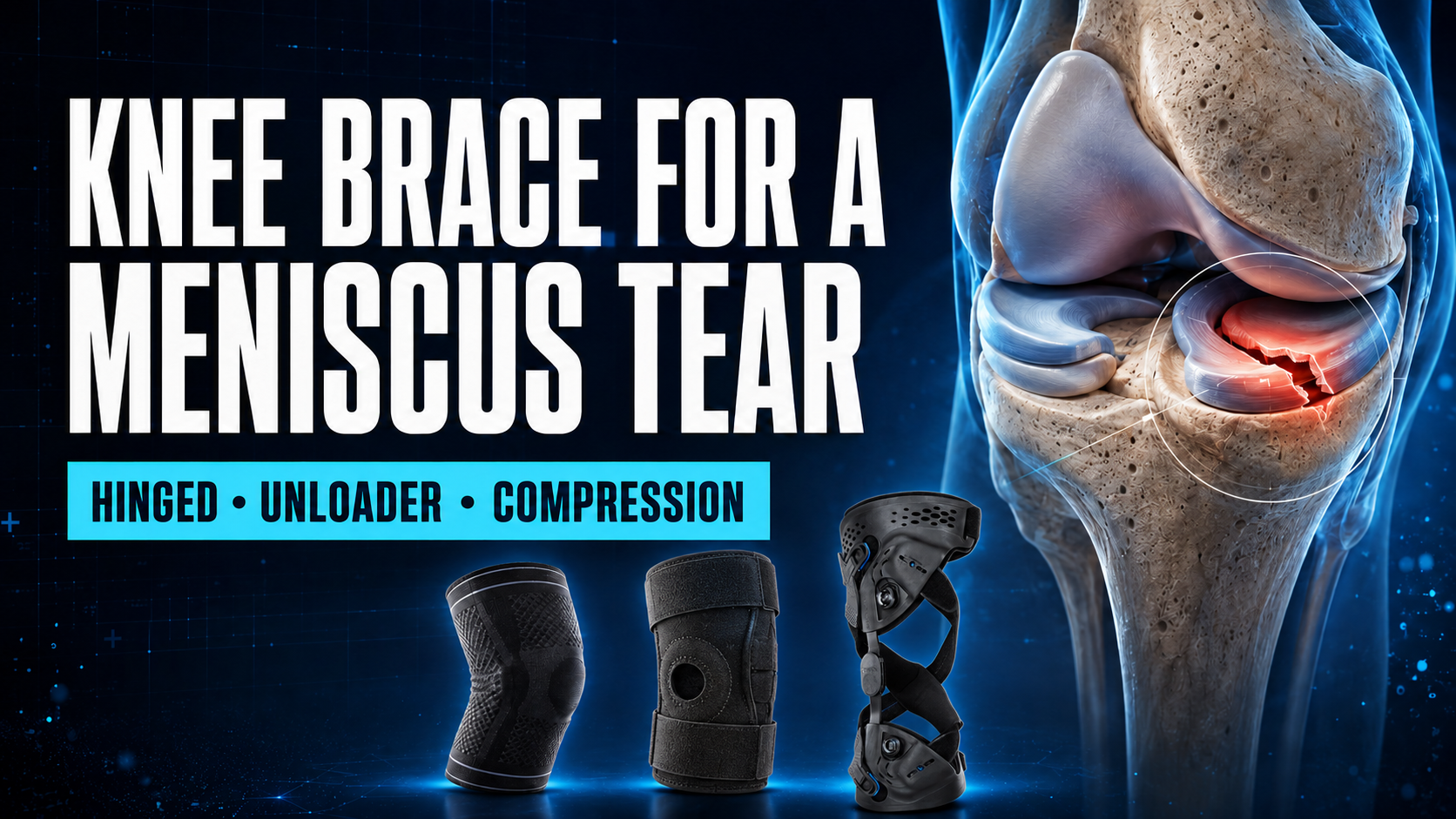
Knee Brace for a Meniscus Tear: How to Match the Brace to the Injury
A knee brace for a meniscus tear can provide compression, improve the feeling of stability, limit unwanted motion or unload a painful knee compartment. The right design depends on whether the problem is an acute traumatic tear, age-related degeneration, accompanying ligament instability or recovery after meniscus surgery.
Quick answer: There is no single best knee brace for every torn meniscus. A compression sleeve offers light symptom support, a hinged knee brace adds side-to-side stability, an unloader brace shifts pressure away from one affected compartment, and a post-operative ROM brace controls motion after a repair. A brace may support the knee, but it does not reconnect torn meniscal tissue.

Why Meniscus Tear Type Matters
Each knee has a medial meniscus on the inside and a lateral meniscus on the outside. These wedge-shaped pieces of fibrocartilage help transmit load and contribute to knee stability. A tear may occur suddenly during a pivot or cutting movement, or gradually as the tissue becomes more vulnerable to degeneration. Symptoms can include joint-line pain, stiffness, swelling, catching, locking, giving way and reduced motion.
A brace cannot identify which meniscus is torn or determine the tear pattern. An X-ray does not show the meniscus itself, although it can reveal arthritis or another cause of pain; MRI is commonly used to evaluate meniscal and other soft-tissue structures. That diagnostic distinction matters because an acute unstable tear, a degenerative tear associated with one-compartment osteoarthritis and a surgically repaired tear have different support needs.
Compression vs. Hinged vs. Unloader vs. Post-Op Knee Braces
| Brace type | Primary function | When it may fit the situation | Important limitation |
|---|---|---|---|
| Compression sleeve | Provides compression, warmth and light proprioceptive support. | Mild symptoms or swelling when a clinician does not require mechanical stabilization. | Does not meaningfully unload one compartment or control a prescribed range of motion. |
| Hinged knee brace | Adds medial-lateral support while permitting knee flexion and extension. | Meniscus symptoms accompanied by mild-to-moderate instability or collateral-ligament involvement. | Standard hinges stabilize; they do not automatically shift pressure away from a damaged compartment. |
| Unloader knee brace | Uses a three-point leverage system to reduce load in the affected medial or lateral compartment. | Degenerative meniscus symptoms associated with unicompartmental knee osteoarthritis. | The correct side, compartment and size must be selected. It is not a substitute for diagnosing an acute tear. |
| Post-op ROM brace | Controls or locks flexion and extension according to prescribed settings. | Surgeon-directed protection after meniscus repair or another knee procedure. | Settings and wear schedule vary by tear, repair and surgical protocol; do not self-adjust them. |
Can a Knee Brace Help a Torn Meniscus?
It may help with symptom management or the perception of joint stability, but expectations should remain realistic. The 2024 EU-US meniscus rehabilitation consensus states that knee bracing can be considered for these purposes while also noting that bracing effects have not been specifically studied for degenerative meniscus tears. Rehabilitation—including progressive motion, strength and neuromuscular work—remains central to nonoperative care when appropriate.
Bracing after meniscus surgery is even more individualized. The same consensus found wide variation in postoperative weight-bearing, range-of-motion and bracing protocols. Some repairs use a locked or limited-motion brace for several weeks, while other protocols allow earlier motion and do not routinely use a brace. Follow the protocol for the specific tear and repair rather than copying another patient's brace settings or timeline.
A brace may help by:
- Providing compression and a more secure feeling during daily movement.
- Reducing side-to-side motion when mild instability is present.
- Unloading the medial or lateral compartment in selected degenerative cases.
- Enforcing prescribed motion limits after surgery.
A brace does not:
- Confirm the diagnosis or reveal the tear pattern.
- Reconnect torn meniscal tissue.
- Make a locked knee safe to ignore.
- Replace rehabilitation, activity modification or surgical follow-up.
How to Choose by Injury and Recovery Scenario
1. Suspected acute meniscus tear
If pain began after a twist, pivot or impact, first determine whether the knee is stable and whether it catches or locks. A hinged brace may add support when instability is part of the problem, but a brace should not delay examination—especially when motion is blocked or weight-bearing is difficult.
2. Degenerative meniscus symptoms with one-compartment arthritis
When imaging and a clinician identify medial or lateral compartment degeneration, an unloader brace may be more purposeful than a simple sleeve. It applies corrective leverage to reduce pressure in the painful compartment. Selection requires the affected knee, the affected compartment and accurate measurements.
3. After meniscus repair
A post-op ROM knee brace may be used to lock extension or limit flexion while the repair is protected. The allowed degrees, weight-bearing status and duration depend on the procedure and tear pattern. Never change ROM stops, unlock the brace or discontinue it without approval from the surgeon or physical therapist.
4. After partial meniscectomy
Recovery after trimming damaged tissue is not identical to recovery after repair. Some patients progress without a long post-op brace, while others receive temporary support based on swelling, weakness, instability or additional procedures. Use the discharge instructions for the operation actually performed.
Shop Knee Braces for Meniscus-Related Support
These OrthoTape products solve different problems. Choose by diagnosis and prescribed function—not by price or brace size alone. OrthoTape is an authorized dealer, and our team can help with product sizing and variant questions at (800) 580-9887. Medical suitability and postoperative settings must come from your clinician.

eLife E-KN056 Hinged Knee Support
Best match: Meniscus injury with mild-to-moderate joint instability when a universal wraparound hinged design is appropriate.
- Manufacturer indications include meniscus injuries.
- Hidden hinges provide collateral support.
- Wraparound neoprene design is easy to apply.

Össur FormFit OA Ease
Best match: A lower-profile unloader for mild-to-moderate unicompartmental OA or a degenerative meniscus problem that may benefit from compartment unloading.
- Single-upright, wraparound design.
- Dynamic Force System strap with tension indicators.
- Available for medial or lateral compartment unloading.

Össur Unloader One X
Best match: Advanced, adjustable unloading for diagnosed unicompartmental OA, degenerative meniscal tears and related compartment-specific conditions.
- Three-point leverage and Dynamic Force System straps.
- SmartDosing dials allow repeatable strap tension.
- Medial/lateral and standard/short configurations.

Össur Rebound Post-Op ROM Brace
Best match: Surgeon-directed protection after meniscal repair or another knee procedure requiring controlled flexion and extension.
- Adjustable ROM hinge with drop-lock.
- Telescoping frame and anti-migration straps.
- ROM settings must follow the prescribed protocol.
Fit and Wear: Four Practical Checks
- Confirm the function first. Stabilizing, unloading and restricting motion are different jobs.
- Measure exactly where the product instructs. Thigh, calf and leg-length measurement locations differ by brace.
- Check circulation and skin. Loosen the brace and contact a clinician if it causes numbness, tingling, color change, coldness, new swelling or skin injury.
- Keep hinges aligned with the knee joint. A brace that slips or rotates may not provide the intended support.
When to Seek Medical Evaluation
Arrange prompt evaluation when the knee is mechanically locked, cannot fully straighten, gives way repeatedly, has major swelling after an injury or cannot comfortably bear weight. Urgent care is also appropriate for visible deformity, severe worsening pain, numbness, a cold or discolored foot, or redness and warmth accompanied by fever.
Related OrthoTape Guides and Collections
Frequently Asked Questions
Can a knee brace heal a torn meniscus?
No. A knee brace cannot reconnect or heal torn meniscal tissue. It may help manage symptoms or improve perceived stability, while rehabilitation, activity modification, medication, injections or surgery may be considered based on the diagnosis.
What type of knee brace is best for a meniscus tear?
There is no single best brace for every meniscus tear. A hinged brace may suit instability, an unloader may help compartment-specific degenerative symptoms, and a post-operative ROM brace should be used only according to the surgeon's protocol.
Is a hinged knee brace good for a meniscus tear?
A hinged knee brace can add medial-lateral stability and may improve confidence during walking, but suitability depends on the tear pattern, instability, pain and any accompanying ligament injury.
When is an unloader brace used for a meniscus problem?
An unloader brace may be considered when degenerative meniscus symptoms occur with one-compartment knee osteoarthritis, especially when the medial or lateral compartment has been identified by a clinician.
Is a compression sleeve enough for a torn meniscus?
A compression sleeve may provide warmth, compression and light symptom support, but it does not provide the side-to-side stability of a hinged brace, the compartment unloading of an unloader or the motion control of a post-operative ROM brace.
Should I sleep in a knee brace for a meniscus tear?
Sleep in a knee brace only when your clinician or surgeon instructs you to do so. This is especially important after meniscus repair, because the brace position and wear schedule are part of the prescribed rehabilitation protocol.
When should meniscus symptoms be evaluated promptly?
Seek prompt evaluation for a locked knee, inability to bear weight, major swelling, repeated giving way, visible deformity, numbness, a cold or discolored foot, or redness and warmth accompanied by fever.
Clinical References
- American Academy of Orthopaedic Surgeons: Meniscus Tears
- Formal EU-US Meniscus Rehabilitation 2024 Consensus: Complete Report
- Össur: OA Ease Product Indications
- Össur: Unloader One X Product Indications
Disclaimer: This article provides general educational information and is not a diagnosis or individualized medical advice. Brace selection, weight-bearing limits and postoperative range-of-motion settings should be determined by a qualified healthcare professional.