
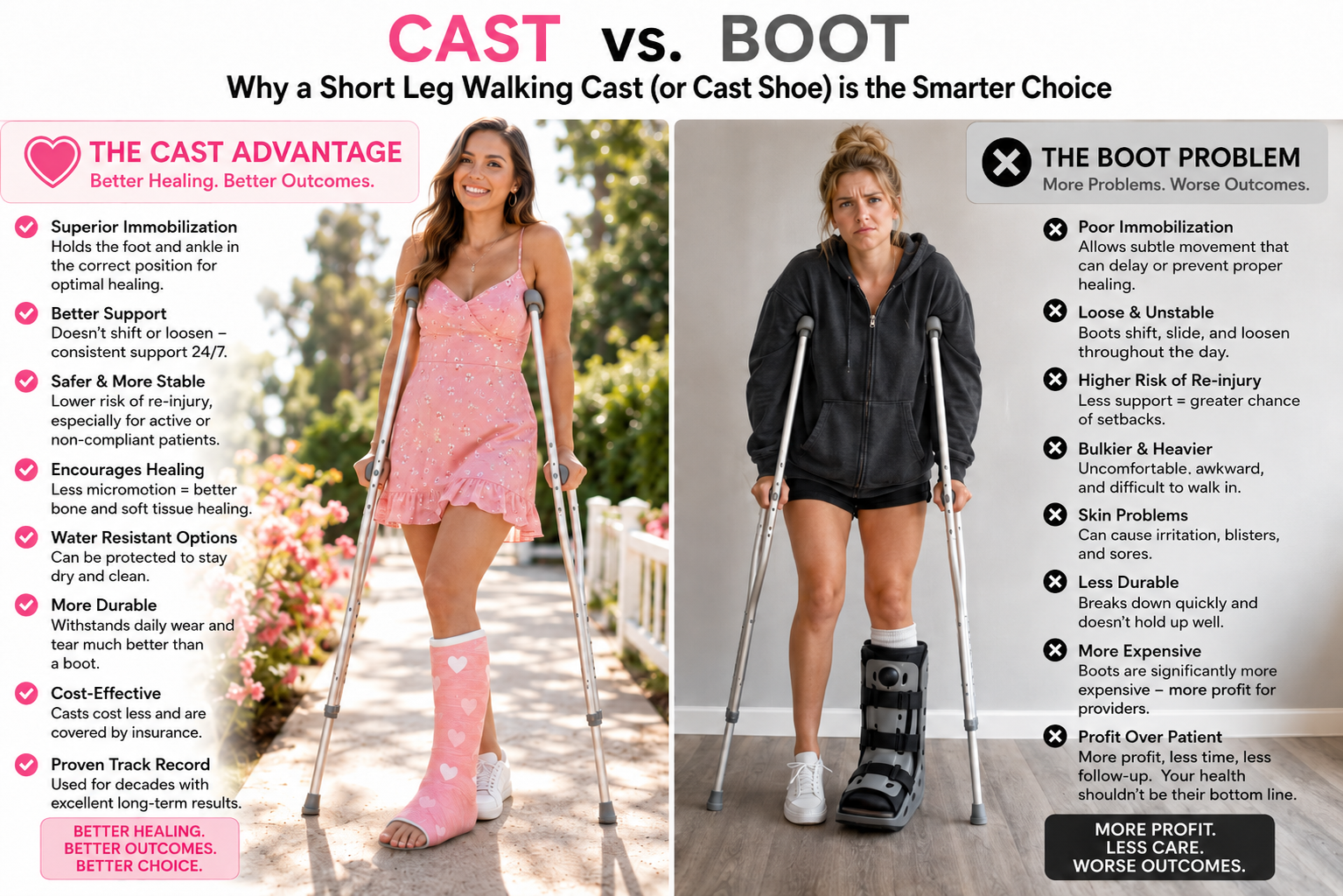
A walking boot may seem easier than a cast. But easier does not automatically mean better protection when a broken foot, ankle fracture, or lower-leg injury needs to be held still.
My View
I believe walking boots have become overused in orthopedics. They have legitimate uses, but for injuries where strict immobilization and continuous protection matter, I believe a properly molded fiberglass cast is too often dismissed in favor of a large removable boot simply because the boot is easier to fit, dispense, remove, and manage.
HSA/FSA Eligible — You May Have a Choice Where You Buy
If you need a medical walking boot, orthopedic boot, fracture boot, fiberglass cast kit, or other DME, do not automatically assume obtaining it through a clinic is your least expensive option. Depending on your insurance plan and DME deductible, purchasing directly can sometimes cost less than your insurance out-of-pocket amount. OrthoTape products are HSA/FSA eligible, and some clinics allow patients to source their own DME or casting supplies. Read the insurance FAQ before deciding. Always check your own insurance benefits and clinic policy.
Many patients leave an orthopedic office or urgent care wearing a medical walking boot, CAM walking boot, fracture boot, orthopedic boot, boot for a broken foot, or boot for a broken ankle instead of a traditional fiberglass cast.
The boot is often presented as the modern choice: convenient, removable, adjustable, and easier to live with.
But patients are not always told what they give up in exchange for that convenience.
A walking boot is convenient because it comes off. A cast protects differently because it stays on.
The Biggest Problem With a Walking Boot: It Is Removable
The feature that makes a CAM boot attractive is also the feature that concerns me most: the patient can take it off.
People remove walking boots to sleep, shower, drive, sit on the couch, loosen pressure, scratch an itch, change socks, cool down, or because the bulky boot is simply annoying.
Some people start taking it off for a few minutes and eventually begin walking around the house without it.
If the purpose of immobilization is to prevent motion while an injury heals, every period spent outside the device removes that protection.
A walking boot sitting beside your bed cannot immobilize your fracture.
A properly applied fiberglass cast does not ask the patient to make that decision over and over again. It stays in place.
Research Shows CAM Boot Compliance Can Be Poor
This is not just a theoretical concern.
A Stony Brook orthopedic study examined patients who had been instructed to remain non-weightbearing in CAM boots after foot and ankle fracture fixation. The researchers found a strict compliance rate of only 29%.
The most commonly reported reason for violating the non-weightbearing restriction was that patients tripped and had to put weight on the operative leg to keep themselves from falling.
The authors concluded that procedures requiring strict non-weightbearing compliance may be more reliably served with casting.
Source: Stony Brook University — Non-Weightbearing in CAM Boots After Foot/Ankle Fracture Fixation.
If the success of the treatment depends on the patient never removing the device, why choose a device designed to be removed?
A Fiberglass Cast Is Built Around the Patient
Most medical walking boots are manufactured in broad size ranges. One boot may be expected to accommodate several shoe sizes.
A fiberglass cast is completely different.
The padding, stockinette, and fiberglass are applied directly around the individual person's leg and foot. The cast is molded around the patient's actual anatomy.
- Medical walking boot: off-the-shelf, removable, strap-dependent, fit-dependent, and compliance-dependent.
- Fiberglass short leg cast: individually molded, non-removable, rigid, and continuously in place.
For an injury where the goal is to restrict unwanted motion, I believe that distinction deserves far more attention than it currently receives.
The OrthoTape Short Leg Cast Kit includes the primary materials used to construct a fiberglass short leg cast. If weight-bearing is later permitted, a Walking Cast Heel or Cast Shoe can provide a walking surface while the fiberglass cast remains securely in place.
Look at How Bulky a Medical Walking Boot Is
There is another issue patients notice immediately: CAM walking boots are huge.
Look at the walking boot in the comparison image. A relatively small foot is surrounded by a thick rocker sole, tall plastic uprights, foam padding, multiple Velcro straps, and a large outer shell.
You then have to carry that bulky orthopedic appliance around everywhere you go.
A short leg fiberglass cast follows the shape of the actual foot and lower leg much more closely. A colored fiberglass cast can also look cleaner and more streamlined than a large black medical boot.
Appearance obviously should not decide fracture treatment by itself. But patients may wear these devices for weeks. Bulk, comfort, confidence, clothing fit, mobility, and how cumbersome the device feels in everyday life matter.
Cast Shoe vs Walking Cast Heel
If weight-bearing is eventually approved, being in a cast does not automatically mean you need a giant medical walking boot.
A walking cast heel attaches directly to the underside of the cast and becomes part of the walking surface.
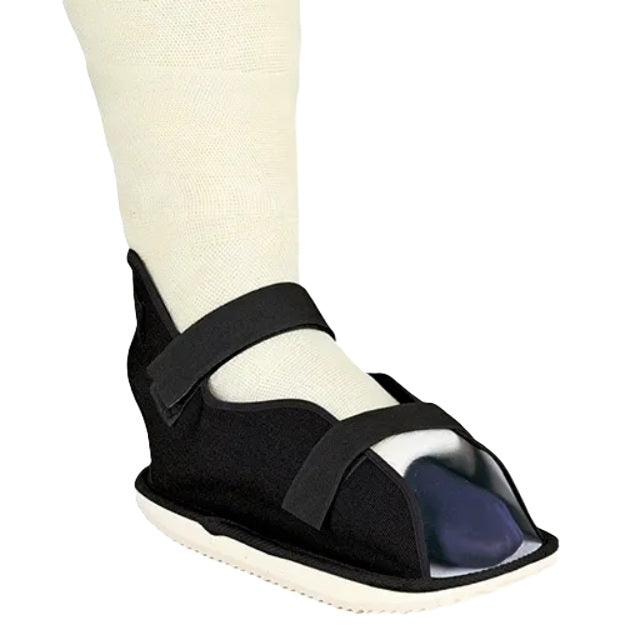
A cast shoe fits over the cast to protect the bottom of the fiberglass or plaster cast and provide traction during permitted walking. The cast shoe can be removed when it is not needed, but the actual cast remains securely on the leg.
That is fundamentally different from a CAM boot. When a CAM boot comes off, the primary immobilization device comes off with it.
With a cast shoe, the walking cover comes off. The protective cast does not.
A Walking Boot Changes the Height of One Leg
One of the most frustrating consequences of a tall CAM boot is the artificial leg-length difference it creates.
The thick rocker-bottom sole makes the injured side taller than the opposite leg. The body then has to compensate as you walk.
Research has documented altered knee and hip biomechanics during CAM boot use, and studies have investigated balance problems related to the leg-length discrepancy created by the boot.
Sources: Effect of Leg Length–Evening Device on Perceived Balance in Patients Wearing a CAM Boot and Biomechanical Effectiveness of Controlled Ankle Motion Boots: Systematic Review.
Hip, Knee and Back Pain During CAM Boot Wear Is Documented
The hip and back complaints many patients report while wearing these boots should not simply be dismissed.
In one prospective study of patients wearing CAM walker boots, 67% reported new or worsened secondary-site pain by the time they transitioned out of the boot.
The areas most susceptible were the lower back, opposite hip, and same-side knee.
Source: Associated Joint Pain With Controlled Ankle Movement Walker Boot Wear.
The injury may be in your foot, but the boot can change how your entire body walks.
A walking cast or cast shoe can also affect gait, so I would not claim any walking device is biomechanically invisible. But the large rocker-bottom CAM boot creates a particularly obvious height difference that patients should understand before assuming the boot is automatically the easier option.
Walking Boots Can Create Pressure and Skin Problems
CAM boots can also create pressure, rubbing, sweating, edge irritation, and skin problems.
A 2025 study examining posterior heel pressure in a commonly used CAM boot found elevated heel pressures when the heel rested against the boot and advised caution during prolonged use.
Source: Peak Contact Pressures of the Posterior Heel in a Commonly Used CAM Orthosis.
A Short Leg Cast Can Restrict Ankle Motion Better Than Some Fracture Boots
This point is especially important because the entire purpose of immobilization is to control unwanted motion.
A biomechanical study compared a short leg cast with low and high fracture boots.
During weight-bearing, researchers measured approximately:
- 3.4° of ankle motion in the short leg cast
- 4.8° in the high fracture boot
- 7.8° in the low fracture boot
The study concluded that the short leg cast and high fracture boot immobilized the ankle during weight-bearing, while the low fracture boot offloaded the ankle but did not immobilize it to the same degree.
Source: Ankle Motion and Offloading in Short Leg Cast and Low and High Fracture Boots.
That is exactly why I question the assumption that putting someone into a removable orthopedic boot automatically represents an advancement over traditional casting.
Non-Removable Protection Has an Important Advantage: You Cannot Cheat
There is an entire body of medical research showing that treatment adherence changes when a protective device can be removed.
In diabetic foot ulcer treatment, for example, non-removable total-contact casts have often produced better outcomes than removable offloading devices.
That research concerns diabetic foot ulcers rather than ordinary fractures, so it should not be treated as proof that every fracture belongs in a cast.
But it illustrates a very simple principle:
A treatment cannot work as intended when the patient is not actually using it.
Sources: Total Contact Casts Versus Removable Offloading Interventions: Meta-Analysis and Health Quality Ontario — Fibreglass Total Contact Casting and Removable Cast Walkers.
Why Have Walking Boots Become So Common?
This is where I think patients should be willing to question the system.
A medical walking boot is easy to keep in inventory. It comes out of a box. It can be fitted quickly. Straps can be adjusted in minutes. The patient walks out wearing it.
Many walking boots are also billable DME under HCPCS codes used for walking orthoses.
A proper fiberglass cast is more labor intensive. Someone has to prepare the limb, apply stockinette and padding, position the joint, apply the casting material, mold it correctly, allow it to cure, check the edges, and monitor the patient.
In my opinion, those workflow differences have helped make the boot an easy default in modern orthopedic practice.
That does not mean every doctor recommending a walking boot is motivated by money or convenience. It means patients should not be afraid to ask whether convenience is influencing the recommendation when a cast may provide more dependable immobilization.
Sources: CMS — Ankle-Foot/Knee-Ankle-Foot Orthoses Policy Article and CGS Medicare — Walking Boots Coverage and Coding Issues.
Patients should ask: Is this walking boot actually the best immobilization method for my injury, or is it simply the easiest device to dispense?
What About Showering? Waterproof Casts Changed That Argument
One of the traditional advantages of a removable medical boot was hygiene.
Traditional cotton cast padding cannot simply be soaked in water. But waterproof cast systems now give appropriate patients another option.
The OrthoH2O Waterproof Short Leg Cast Kit uses a waterproof casting system designed for showering, bathing, and swimming when approved for the patient's treatment.
If the main argument for a removable boot is that you want to shower, I believe it is reasonable to ask whether a waterproof cast is an option instead.
When a Walking Boot Really Does Make Sense
I am not arguing that CAM boots should disappear.
A medical walking boot can make sense for certain stable fractures, sprains, soft-tissue injuries, post-operative protocols, stress fractures, wound monitoring, swelling management, staged rehabilitation, and circumstances where controlled removability is an intentional part of treatment.
The point is that removability should be a feature you actually need, not an automatic reason to abandon a rigid cast.
If an injury needs to be held still, if patient compliance is questionable, if the boot fits poorly, or if the patient repeatedly removes it, I believe a properly molded fiberglass cast deserves serious consideration.
Do Not Be Afraid to Ask Your Doctor for a Cast
Patients sometimes act as though they have no voice once a medical walking boot is brought into the exam room.
You can ask questions.
- Would a fiberglass cast immobilize this injury better?
- Why does this particular injury need a removable device?
- What happens if I take the boot off too often?
- Does this boot fit my actual foot correctly?
- Would a short leg cast with a cast shoe or walking cast heel work once weight-bearing is permitted?
- Could a waterproof cast solve the bathing problem?
A recommendation is not a command that prevents you from asking about alternatives.
My Final Take: The Fiberglass Cast Never Stopped Working
I believe the walking boot has been elevated too quickly from a useful orthopedic tool to a routine default.
A boot is removable.
A boot depends on straps.
A boot depends on patient compliance.
A boot is usually selected from a size range instead of being molded to the patient's anatomy.
A boot can create a substantial leg-height difference.
A boot can alter gait.
And a boot cannot protect the injury while it is sitting on the floor beside the patient.
A fiberglass cast is simple by comparison.
It is molded to the patient. It is rigid. It stays on. It protects continuously.
Modern fiberglass colors, waterproof cast liners, cast shoes, and walking cast heels have also eliminated many of the old lifestyle complaints associated with casting.
If you are handed a giant medical walking boot, do not automatically assume it is the better or more advanced choice. Ask whether a properly molded fiberglass cast would protect your injury better.
Prefer a Fiberglass Cast? Explore the Options
If a fiberglass short leg cast is appropriate for your injury, you do not have to give up everyday mobility. Choose a traditional cast kit, add a walking cast heel or removable cast shoe when weight-bearing is permitted, or choose a waterproof casting system for showering and swimming.



Your Treatment Still Requires a Boot?
Compare Medical CAM Walking Boots
Some injuries genuinely require a removable medical walking boot. If that is the treatment chosen for you, compare orthopedic walking boots, fracture boots, air boots, tall CAM boots, and short walking boots before settling for whatever happens to be available at the clinic.
Shop Medical Walking BootsBuy with confidence: OrthoTape.com is an authorized dealer of orthopedic bracing, casting, and immobilization products. Shop authentic products, fresh inventory, and HSA/FSA-eligible medical supplies from a U.S.-based medical supply company.
Frequently Asked Questions
Should I get my walking boot or cast supplies through my doctor or buy them myself?
It depends on your insurance plan, DME deductible, clinician's treatment plan, and clinic policy. Some patients find that purchasing a medical walking boot, orthopedic boot, fracture boot, or cast supplies directly costs less than their out-of-pocket cost through insurance, especially when a DME deductible applies. OrthoTape products are HSA/FSA eligible, so eligible patients may be able to use pre-tax funds. Some clinics allow patients to source their own DME or casting supplies. Ask your clinician whether bringing or purchasing your own supplies is permitted, and confirm coverage and eligibility with your insurance plan or HSA/FSA administrator before purchasing.
Can I ask my doctor for a cast instead of a walking boot?
Yes. If a walking boot is recommended, it is reasonable to ask whether a fiberglass cast is also appropriate for your injury and why one option is preferred over the other. Some injuries benefit from removability, swelling adjustment, wound access, or staged rehabilitation, while others may benefit from continuous immobilization. The final choice depends on the injury, imaging, stability, swelling, skin condition, circulation, and treatment goals.
Is a walking boot better than a cast for fracture healing?
Not necessarily. In my view, walking boots are often used too routinely when a properly molded cast could provide more dependable immobilization. A boot is removable and depends on fit, strap adjustment, and patient compliance. A cast is custom-molded and stays in place. For injuries where strict protection is the priority, that difference matters.
Why can a short leg cast with a walking cast heel be better than a medical boot?
For some injuries, a short leg cast with a walking cast heel provides continuous protection because the cast is custom-molded to the patient's limb and cannot be casually removed. When weight-bearing is clinically approved, the walking cast heel provides a durable walking surface while the cast continues to immobilize the injured area. A medical walking boot remains removable and depends more heavily on correct fit, strap adjustment, and patient compliance.
What is the biggest limitation of a medical walking boot?
A major limitation is removability. A medical walking boot only protects the injury when it is worn correctly and kept on as instructed. Research from Stony Brook involving patients told to remain non-weightbearing in CAM boots after foot and ankle fracture fixation found a strict compliance rate of 29%. When consistent immobilization is important, a non-removable cast can remove much of that compliance variable.
Can a walking boot cause hip, knee, or back pain?
It can. A CAM walking boot can create a temporary leg-length difference because the booted side is taller than the uninjured side. Research has documented altered gait mechanics and secondary-site pain during CAM boot use, including pain involving the lower back, hip, and knee. Patients who develop new pain while wearing an orthopedic walking boot should discuss fit, gait, and possible leg-length compensation with their clinician.
Can a walking boot contribute to tripping or falls?
It can affect gait and balance because a medical walking boot is bulky and changes the height and mechanics of the injured leg. In the Stony Brook study cited in this article, tripping was the most common reason patients reported violating non-weightbearing instructions. Follow weight-bearing instructions and use prescribed mobility aids when needed.
Are walking boots custom fit?
Most medical walking boots are off-the-shelf devices offered in broad shoe-size ranges rather than being individually molded to the patient's limb. Correct sizing, liner placement, strap adjustment, and inflation when using an air boot are therefore important. A traditional short leg cast is molded directly around the individual patient's anatomy.
Can a walking boot cause skin problems or pressure injuries?
Medical walking boots can cause rubbing, edge irritation, sweating, redness, soreness, or pressure areas in some patients. A 2025 study cited in this article measured elevated posterior heel pressures in a commonly used CAM boot under certain positioning conditions. Report persistent redness, numbness, increasing pain, sores, or pressure areas to your healthcare provider.
Why do doctors prescribe walking boots instead of casts?
Walking boots can be clinically appropriate, but they are also fast to stock, fit, remove, adjust, and dispense. A fiberglass cast requires trained application, padding, molding, curing time, and follow-up. In my opinion, those workflow advantages can make the boot an easy default. Patients can reasonably ask whether the boot is being chosen because removability is medically important for their injury or because it is simply the more convenient option to dispense.
Can I shower with a cast instead of using a boot?
Some waterproof cast systems are designed to allow showering, bathing, or swimming when the treating clinician approves their use. A waterproof cast uses specialized water-resistant or quick-draining liner materials rather than traditional cotton padding. Ask whether a waterproof short leg cast is appropriate for your injury and follow the manufacturer's drying and care instructions.
What should I ask before accepting a walking boot?
Ask why a removable boot is preferred for your injury, whether a fiberglass cast would provide more reliable immobilization, whether you are allowed to bear weight, how long the boot must remain on each day, whether it may be removed for sleep or bathing, how to confirm the correct size and strap tension, and whether the boot creates a meaningful leg-length difference.
Editorial disclosure: This article reflects the author's opinion about the increased use of removable walking boots and is supported by the research cited above. It is intended for patient education and discussion, not individual diagnosis. Fracture treatment depends on injury type, alignment, stability, imaging, swelling, circulation, skin condition, and other individual factors.
References
- Stony Brook University — Non-Weightbearing in CAM Boots After Foot/Ankle Fracture Fixation
- Effect of Leg Length–Evening Device on Perceived Balance in Patients Wearing a CAM Boot
- Associated Joint Pain With Controlled Ankle Movement Walker Boot Wear
- Biomechanical Effectiveness of Controlled Ankle Motion Boots: Systematic Review
- Ankle Motion and Offloading in Short Leg Cast and Low and High Fracture Boots
- Peak Contact Pressures of the Posterior Heel in a Commonly Used CAM Orthosis
- CMS — Ankle-Foot/Knee-Ankle-Foot Orthoses Policy Article
- CGS Medicare — Walking Boots Coverage and Coding Issues
- Total Contact Casts Versus Removable Offloading Interventions: Meta-Analysis
- Health Quality Ontario — Fibreglass Total Contact Casting and Removable Cast Walkers