
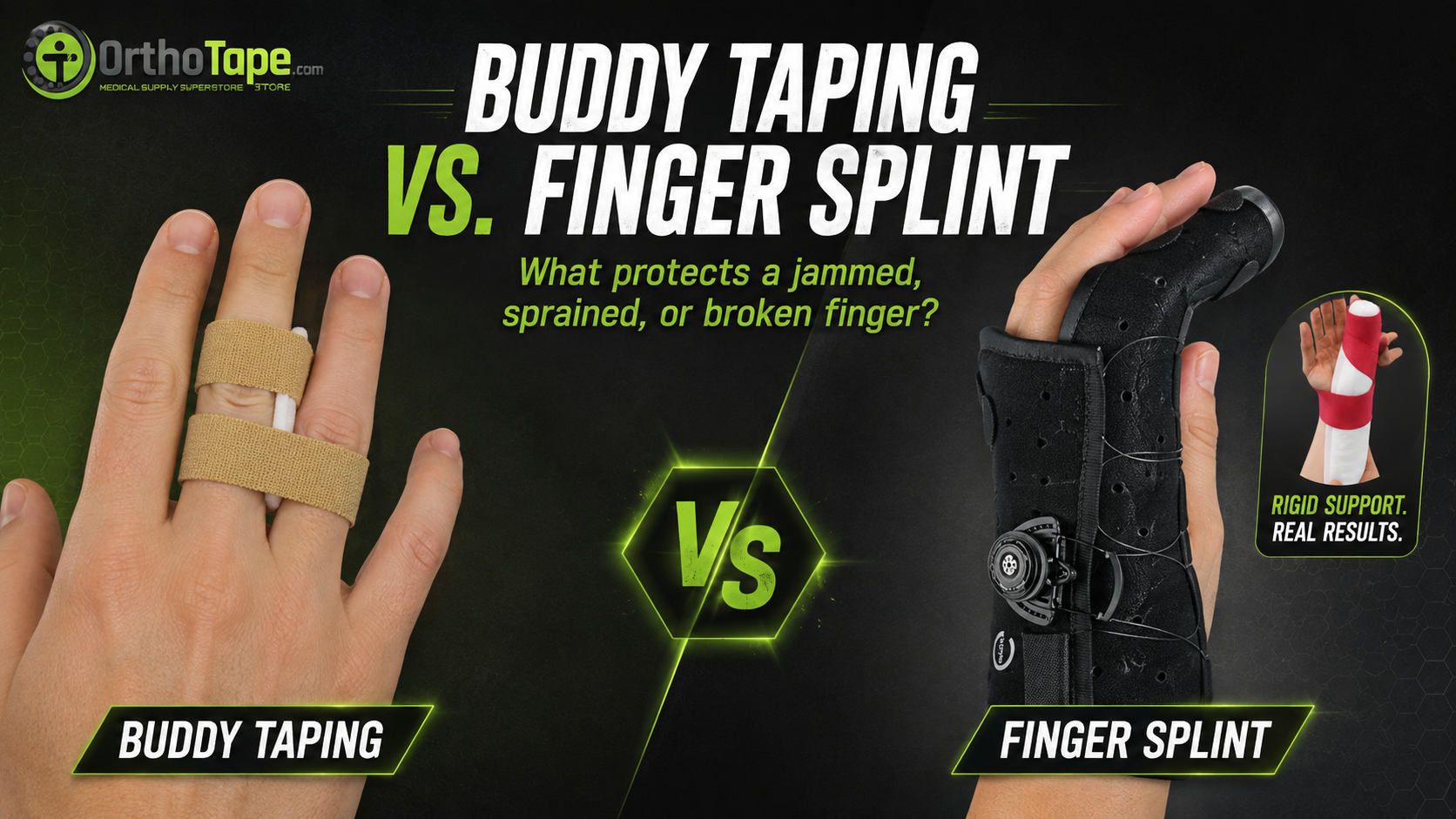
Buddy Taping vs. Finger Splint: Which Is Better for a Jammed, Sprained or Broken Finger?
Buddy taping, a rigid finger splint and a gutter brace provide different levels of protection. The right choice depends on whether the injury is stable, which joint or bone is involved, whether the finger is aligned correctly and how much motion the clinician wants to allow.
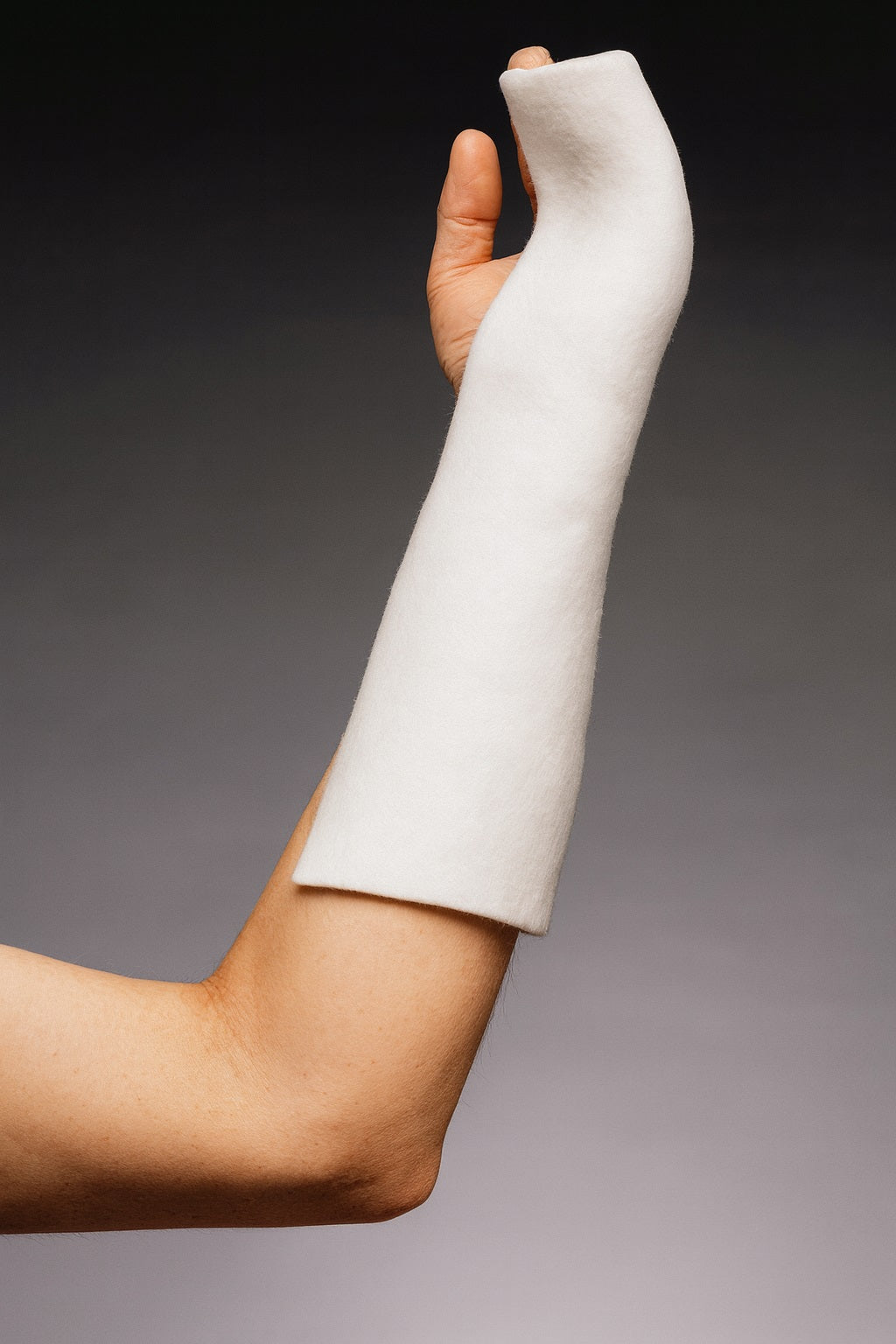
ULNAR GUTTER SPLINT: rigid hand and finger protection
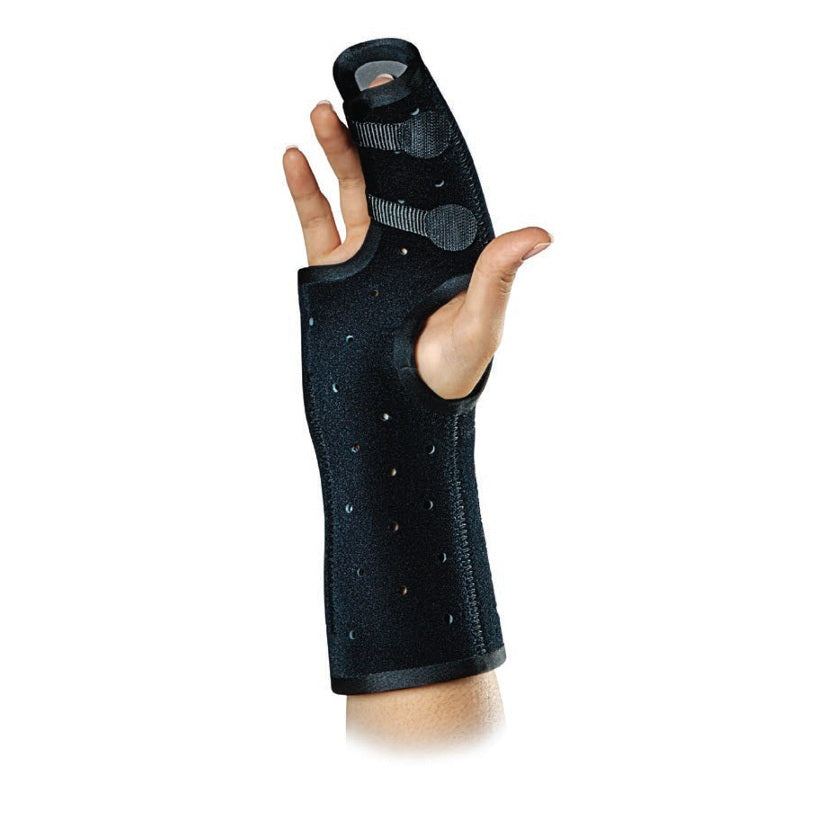
RADIAL GUTTER BRACE: structured support for the index and middle finger side
Buddy Tape, Finger Splint or Gutter Brace?
Buddy taping
The injured finger is secured to an adjacent finger, which acts as a movable splint. It provides side-to-side support while allowing some bending and straightening.
Rigid finger splint
A metal, plastic or molded splint can hold one or more finger joints in a prescribed position. It provides more motion restriction than buddy taping.
Gutter splint or brace
A radial or ulnar gutter device supports selected fingers, their metacarpals and part of the wrist. It is used when the injury extends beyond a single stable finger joint.
Comparison Table
| Feature | Buddy Taping | Rigid Finger Splint | Radial or Ulnar Gutter Support |
|---|---|---|---|
| Main purpose | Guide the injured finger with an adjacent finger | Hold a selected joint or bone in a prescribed position | Control selected fingers, metacarpals and part of the wrist |
| Amount of motion | Allows controlled finger motion | Restricts the targeted joint more strongly | Provides the greatest hand-level control of these three options |
| Commonly considered for | Selected stable sprains and nondisplaced fractures | Fingertip fractures, tendon injuries or joints needing fixed positioning | Metacarpal fractures, multiple-digit injuries or less stable hand injuries |
| Requires diagnosis first? | Yes—rotation, displacement and tendon injury must be excluded | Yes—the correct joint and position must be identified | Yes—side, injured metacarpals and hand position must be prescribed |
| Key risk if used incorrectly | Skin injury, circulation problems or inadequate protection | Stiffness, pressure injury or immobilizing the wrong joint | Poor alignment, pressure, stiffness or insufficient fracture control |
First: Is It Really Just a Jammed Finger?
“Jammed finger” describes the way an injury happened, not the diagnosis. A direct impact can cause a mild sprain, fracture, dislocation, volar plate injury, central slip injury or tendon disruption. These conditions can look similar during the first hours because pain and swelling may obscure deformity.
The American Academy of Family Physicians notes that finger injuries are often underestimated and that correct treatment depends on identifying the injured tendon, ligament, joint or bone. Radiographs are commonly used when fracture or dislocation is suspected. Review the AAFP overview of acute finger injuries.
When Buddy Taping May Be Appropriate
Buddy taping uses the neighboring finger as a dynamic splint. This can protect the injured digit while preserving some motion and reducing stiffness. It may be selected after evaluation for a stable collateral-ligament sprain, a reduced stable dislocation or a minimally angulated, stable phalanx fracture.
AAFP guidance reports that uncomplicated middle and proximal phalanx fractures with minimal angulation may be managed with buddy splinting, while larger angulation, displacement or malrotation often requires reduction or surgery. Read the AAFP review of common finger fractures and dislocations.
NHS patient guidance explains that buddy strapping protects the injured finger while still allowing movement and warns that the straps must not be tight enough to impair circulation or increase swelling. View Oxford University Hospitals buddy-strapping guidance.
When a Rigid Finger Splint Is Safer
A rigid finger splint is used when a particular joint or bone must remain in a defined position. Examples include selected distal phalanx fractures, mallet finger, certain dislocations after reduction and injuries where approved movement would place healing tissue at risk.
The exact position matters. A splint that holds the wrong joint, blocks too much movement or permits the injured joint to bend can delay recovery. Merck’s clinical instructions distinguish fixed finger splinting from buddy taping and note that splint placement depends on the injured structure. See Merck’s fixed finger splint guidance.
When a Gutter Splint or Brace Is Needed
Gutter supports extend beyond a single finger. They stabilize selected digits, the corresponding metacarpals and part of the wrist. They are therefore used for hand injuries that buddy taping or a small finger splint cannot adequately control.

The EXOS Radial Gutter Fracture Brace is designed for clinician-directed stabilization of the second and third metacarpals and associated joints. The EXOS Boxer’s Fracture Brace is the ulnar-side counterpart for selected fourth- and fifth-metacarpal injuries.
The Thumb Is Different
The thumb should not automatically be treated like one of the fingers. Its joint anatomy, opposition movement and collateral ligaments require different support. A clinician may prescribe a thumb spica splint for a thumb fracture, skier’s thumb, gamekeeper’s thumb or a significant thumb sprain.


Compare OrthoTape’s Ossur Formfit Thumb Spica Splint with the more rigid Fiberglass Thumb Spica Splint Kit when a clinician has recommended thumb-and-wrist immobilization.
How to Buddy Tape an Injured Finger
Use these general steps only after a clinician has confirmed that buddy strapping is appropriate for the diagnosed injury. The recommended neighboring finger, tape location and duration may vary.
- Confirm that buddy taping was recommended. Remove rings and have the injury evaluated when a fracture, dislocation, tendon injury or significant ligament injury is possible. Confirm which neighboring finger should be used and how long the strapping should remain in place.
- Inspect and dry the skin. Check both fingers for cuts, blisters, drainage, excessive swelling or skin breakdown. Clean and fully dry the skin before applying the straps.
- Place padding between the fingers. Insert a thin piece of gauze or soft padding between the fingers to reduce friction, trapped moisture and pressure at the skin surfaces.
- Align the fingers in a relaxed position. Keep the fingers naturally aligned without forcing a crooked or deformed finger straight. A visibly rotated or displaced finger requires medical assessment rather than forceful home correction.
- Apply two narrow straps while avoiding the joints. Place one strap around the finger segments below the injured joint and a second strap above it. Keep the tape off the knuckles and finger-joint creases so approved motion is not unnecessarily blocked.
- Check circulation, sensation and skin regularly. Confirm that both fingertips remain warm and normally colored and that sensation has not changed. Replace wet, dirty or loose strapping and seek advice for numbness, color change, worsening pain or skin damage.
Common Buddy-Taping Mistakes
Taping over the joints
Straps across the knuckles or finger-joint creases can unnecessarily block motion and increase skin pressure.
Wrapping too tightly
Tape that causes throbbing, numbness, discoloration, coldness or increased swelling must be loosened and reassessed.
No padding between fingers
Skin-on-skin moisture and friction can cause maceration, blisters and sores during prolonged strapping.
Taping a rotated finger
A finger that crosses or overlaps another finger when making a fist may be malrotated and requires medical evaluation.
Leaving wet tape in place
Wet or dirty strapping can damage skin. Replace it according to the clinician’s instructions and dry the skin completely.
Using tape instead of a diagnosis
Buddy taping cannot identify a fracture, tendon injury or unstable dislocation. Significant injuries need examination and often imaging.
Warning Signs That Need Prompt Evaluation
- The finger appears crooked, rotated or shortened.
- The injured finger crosses over another finger when making a gentle fist.
- You cannot actively bend or straighten one of the finger joints.
- There is an open wound, nail-bed injury or exposed bone.
- The finger is numb, cold, pale, blue or increasingly swollen.
- Pain or pressure worsens after taping or splinting.
- The injury followed a high-force impact or crush.
Shop Finger, Hand and Thumb Support Options
Ulnar Gutter Fiberglass Splint Kit
A professional pre-padded fiberglass splint kit for selected ring-finger, small-finger and fourth- or fifth-metacarpal injuries.
View Ulnar Gutter Kit
EXOS Radial Gutter Fracture Brace
A thermoformable clinician-fitted brace for selected second- and third-metacarpal injuries on the index and middle finger side.
View Radial Gutter Brace
EXOS Boxer’s Fracture Brace
A moldable ulnar gutter fracture brace for clinician-directed stabilization of the fourth and fifth metacarpals and digits.
View EXOS Boxer Brace
Ossur Formfit Thumb Spica
A sized left- or right-specific thumb-and-wrist stabilizer for selected thumb sprains, ligament injuries and post-cast protection.
View Thumb SpicaBrowse the complete OrthoTape thumb splint and finger brace collection, shop the thumb sprain and finger fracture collection, or review our broader guide to wrist and hand splint types.
Frequently Asked Questions
Is buddy taping better than a finger splint?
Neither option is universally better. Buddy taping allows controlled movement and may be prescribed for selected stable sprains or nondisplaced fractures. A rigid finger splint is used when a particular joint or bone must remain more still. The diagnosis, alignment, stability and injured structure determine the correct treatment.
Can a broken finger be treated with buddy taping?
Some stable, minimally angulated finger fractures may be treated with buddy taping after medical evaluation. Displaced, rotated, unstable, open or joint-involving fractures may require reduction, a rigid splint, a gutter splint or surgery.
How tight should buddy tape be?
The tape should guide the injured finger with its neighbor without causing throbbing, numbness, tingling, color change, coldness or increased swelling. Loosen or remove the tape and seek clinical advice if circulation or sensation changes.
Where should buddy tape be placed?
Two narrow straps are commonly placed around the finger segments above and below the injured joint while avoiding direct tape placement across the finger joints. Thin gauze or soft padding between the fingers can reduce moisture and skin friction.
How long should a finger remain buddy taped?
The duration depends on the diagnosis and healing progress. Some minor injuries require a short period, while selected stable fractures may require several weeks. Follow the treating clinician’s schedule and do not extend or stop immobilization based only on pain.
Can the thumb be buddy taped to the index finger?
The thumb usually requires a different support because its anatomy and movement differ from the fingers. A clinician may prescribe a thumb spica splint or brace for thumb fractures, ligament injuries or significant sprains.
When is a radial or ulnar gutter splint used?
A radial gutter design supports the index and middle finger side of the hand, including the second and third metacarpals. An ulnar gutter design supports the ring and small finger side, including the fourth and fifth metacarpals. These devices provide more hand and wrist control than buddy taping.
What finger-injury warning signs require prompt medical care?
Prompt evaluation is needed for visible deformity, finger rotation or crossing, an open wound, severe swelling, loss of movement, numbness, a cold or discolored finger, uncontrolled pain, or a finger that cannot actively bend or straighten after injury.
Clinical References
- Merck Manual Professional Edition: How to Buddy-Tape Fingers
- American Family Physician: Common Finger Fractures and Dislocations
- American Family Physician: Acute Finger Injuries—Tendons and Ligaments
- Oxford University Hospitals: Buddy Strapping
- Merck Manual Professional Edition: How to Apply a Fixed Finger Splint