
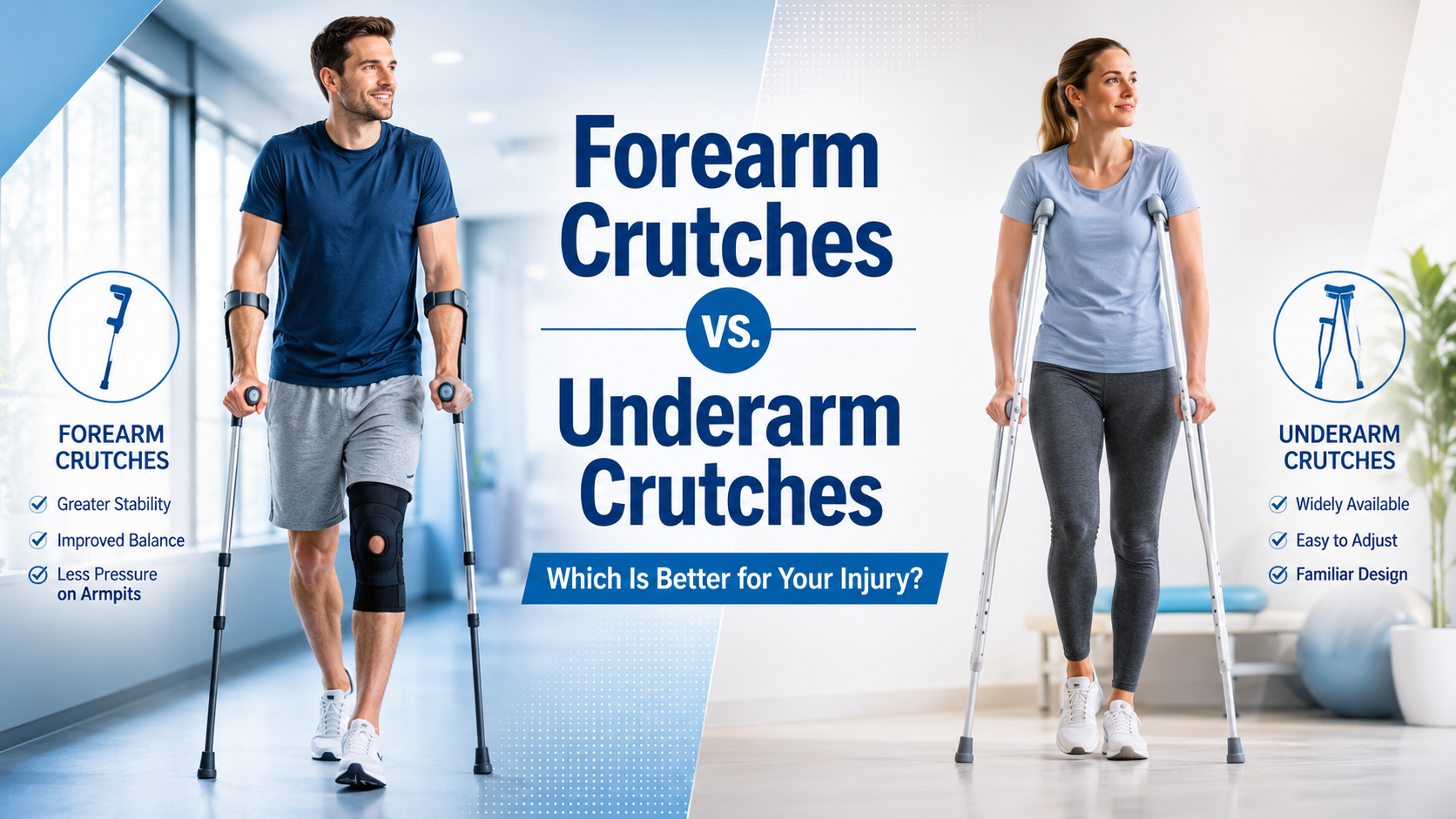
Forearm crutches and underarm crutches both reduce weight on an injured leg, foot or ankle, but they feel and function differently. Underarm crutches are often selected for temporary recovery, while forearm crutches may offer better maneuverability and everyday convenience for longer-term users. The right choice depends on balance, upper-body strength, expected recovery time and proper fitting.
Quick answer: Are forearm crutches or underarm crutches better?
Neither style is automatically better for everyone. Underarm crutches are familiar and may be easier for many first-time users during short-term recovery. Forearm crutches are less bulky and may provide better maneuverability for people who need crutches for a longer period or use them regularly.
Important safety note: Crutches should be professionally fitted when possible. Body weight should be supported through the hands, not by hanging on underarm pads. Incorrect crutch fit or technique can cause pain, instability, falls, skin irritation and nerve compression.
Forearm Crutches vs. Underarm Crutches at a Glance
The best crutch type depends on how long support is needed, the user's balance and upper-body control, and whether the priority is quick temporary use or a more compact mobility aid for regular use.
| Feature | Forearm crutches | Underarm crutches |
|---|---|---|
| Other names | Elbow crutches, Lofstrand crutches and Canadian crutches | Axillary crutches |
| Common use | Longer-term use, repeated use and active daily mobility | Temporary injury recovery and postoperative use |
| Contact points | Handgrip and forearm cuff | Handgrip and upper support below the armpit |
| Learning curve | May require more practice initially | Often more familiar to first-time users |
| Maneuverability | Usually more compact and agile | Usually bulkier |
| Long-term convenience | Often preferred by regular crutch users | May become cumbersome during extended use |
| Incorrect-use risk | Hand, wrist and forearm strain | Hand strain plus underarm pressure and possible nerve compression |
What Are Forearm Crutches?
Forearm crutches have a handgrip and a cuff that wraps partially or fully around the forearm. They remain below the elbow rather than extending to the armpit. Forearm crutches are also called elbow crutches, Lofstrand crutches or Canadian crutches.
Some users prefer forearm crutches because they are less bulky and easier to maneuver in tight spaces. They are available in half-cuff, full-cuff, anatomical-grip, youth, folding and bariatric configurations.

Common forearm crutch features
- Half cuff or full cuff
- Adjustable grip and cuff height
- Standard, soft or anatomical handgrips
- Adult, youth and bariatric sizing
- Replaceable rubber tips and grips
Shop OrthoTape's Forearm Crutches Collection .
What Are Underarm Crutches?
Underarm crutches have a handgrip and an upper support that sits below the armpit. They are commonly used after a broken leg, foot or ankle injury and during postoperative recovery because they are familiar and generally require less initial training.
The top pad should not carry body weight or press firmly into the armpit. Properly fitted underarm crutches leave clearance below the armpit while the hands support the user through the grips.

Common underarm crutch features
- Padded upper support below the armpit
- Adjustable handgrips and overall height
- Lightweight aluminum construction
- Replaceable pads, grips and rubber tips
Shop OrthoTape's Underarm Crutches Collection .
Half-Cuff vs. Full-Cuff Forearm Crutches
The forearm cuff affects how easily the arm enters and exits the crutch and how securely the crutch remains positioned around the forearm.

Half cuff: Useful for people who frequently transition between walking, sitting and standing or prefer easier crutch removal.
Full cuff: May be preferred by longer-term users or people who want greater forearm contact and security.
Advantages and Disadvantages of Each Crutch Type
Forearm crutch advantages
- Less bulky and easier to maneuver in confined spaces
- No upper pad positioned near the armpit
- Multiple cuff and grip styles for longer-term users
- Often easier to carry, store and use in daily life
Forearm crutch disadvantages
- Can require more practice and coordination initially
- Still place substantial pressure through the hands and wrists
- May not feel as immediately stable to some first-time users
Underarm crutch advantages
- Familiar design commonly used after injury or surgery
- Often easier to learn for temporary use
- Widely available and generally economical
Underarm crutch disadvantages
- Bulkier than forearm crutches
- Incorrect fit or leaning can create dangerous underarm pressure
- May be less convenient for regular long-term use
Which Crutches May Be Better for Different Situations?
The following table describes common patterns rather than personal treatment recommendations. A physician or physical therapist should determine weight-bearing status and confirm safe crutch selection and technique.
| Situation | Crutch type often considered | Reason |
|---|---|---|
| Temporary broken foot, ankle or leg | Underarm crutches | Familiar option that many first-time users learn quickly |
| Longer-term or repeat crutch use | Forearm crutches | Less bulky and often easier to integrate into daily mobility |
| Need for ergonomic hand positioning | Forearm crutches with an anatomical grip | Contoured handles may place the wrist in a more neutral position |
| Need for increased weight capacity | Bariatric forearm crutches or appropriately rated underarm crutches | The crutch must meet or exceed the user's weight and fitting requirements |
| Child or teenager | Youth-sized forearm or underarm crutches | Correct frame proportions and adjustment range are essential |

How to Fit Crutches Correctly
Forearm crutch fitting basics
- Wear the shoes normally used while walking.
- Adjust the handgrip near wrist-crease level while standing upright with the arm relaxed.
- Position the cuff below the elbow without restricting elbow movement.
- Confirm that the elbow remains slightly bent while holding the grip.
- Make sure both forearm crutches are adjusted evenly.
Underarm crutch fitting basics
- Leave clearance between the top pad and the armpit.
- Adjust the handgrips so the elbows remain slightly bent.
- Support body weight through the hands rather than resting on the top pads.
- Confirm that both underarm crutches are adjusted to the same height.
Stop and reassess the fit if:
- You must shrug the shoulders to use the crutches
- The handgrips cause excessive elbow bending or completely straight elbows
- The forearm cuff pinches, slides or presses against the elbow
- You experience persistent hand, wrist, forearm or underarm pain
- The rubber tips are worn, cracked or slipping
Common Crutch Mistakes
- Leaning on underarm pads: Body weight should be carried through the hands.
- Using the wrong height: Incorrect adjustment changes posture, stability and comfort.
- Ignoring worn tips: Smooth, cracked or hardened rubber tips reduce traction.
- Using a crutch above its weight rating: This can cause equipment failure and serious falls.
- Skipping gait instruction: Professional training can reduce falls and upper-body strain.
Suggested Forearm Crutches, Underarm Crutches and Accessories
Each recommendation below links directly to the relevant OrthoTape product or collection and displays the actual main product image so shoppers can see the design before selecting an option.
Adjustable adult forearm crutches with an open half cuff for easier arm entry and removal.
View Model 484
A fixed four-inch full cuff surrounds the forearm for greater contact and a secure fit.
View Model 471
Full-cuff adult forearm crutches with a contoured grip designed for a more neutral wrist position.
View Model 495
Heavy-duty full-cuff forearm crutches with a manufacturer-listed capacity of up to 400 pounds.
View Model 499
Youth-proportioned half-cuff forearm crutches for children and teenagers.
View Youth Crutches
Compare OrthoTape underarm crutch options for adults, youth and temporary injury recovery.
Shop Underarm Crutches
Pivoting replacement tips designed to improve ground contact and reduce wrist and arm strain.
View Pivoflex Tips
Compare half-cuff, full-cuff, anatomical-grip, youth, folding and bariatric forearm crutches.
Shop the CollectionFrequently Asked Questions About Forearm and Underarm Crutches
Are forearm crutches better than underarm crutches?
Not in every situation. Underarm crutches may be easier for temporary recovery, while forearm crutches are often preferred for longer-term, repeat or more active daily use.
Which crutches are best for a broken leg?
Many people use underarm crutches for a temporary broken leg, ankle or foot injury. Forearm crutches may also be appropriate. The best option depends on the injury, weight-bearing restrictions, balance, strength and professional guidance.
Are forearm crutches harder to use?
They may require more initial practice, but many users find them more convenient and maneuverable once correctly fitted and learned.
Which crutches are better for long-term use?
Forearm crutches are frequently chosen for longer-term or regular use because they are less bulky and are available with multiple cuff and grip configurations.
Should underarm crutches touch the armpits?
No. Properly fitted underarm crutches leave clearance below the armpits. The user's weight should be supported through the hands.
What is the difference between half-cuff and full-cuff forearm crutches?
A half cuff is open behind the forearm and allows easier entry and exit. A full cuff surrounds more of the forearm and may feel more secure.
Can forearm crutches be used while non-weight-bearing?
Yes, when the treating clinician permits and the user has the strength, balance and training required to maintain the prescribed weight-bearing restriction.
How often should crutch tips be replaced?
Inspect crutch tips regularly. Replace them when the tread is worn smooth, the rubber is cracked or hardened, or traction has noticeably decreased.
Clinical Sources and Editorial Information
Editorial disclosure: OrthoTape.com is operated by K10 Medical Supply, LLC and sells some of the crutches and replacement products discussed in this guide.
Medical information: This article is educational and does not replace evaluation, fitting, gait training or instructions from a qualified healthcare professional or physical therapist.
Clinical references: