

Wrist and hand splints are shaped differently because each design controls a different combination of joints and movements. A volar wrist splint supports the palm side of the wrist, a sugar tong splint extends around the elbow to limit forearm rotation, a thumb spica includes the thumb, and gutter splints support selected fingers and metacarpals.
See the main wrist and hand splint designs
Quick answer: What are the main types of wrist and hand splints?
Common designs include the volar wrist splint, dorsal wrist splint, sugar tong splint, thumb spica splint, ulnar gutter splint, radial gutter splint and posterior long arm splint. The correct design depends on the injured bone, joint or ligament; the amount of swelling; whether forearm rotation must be controlled; and whether the thumb, fingers or elbow need to be included.
Important medical note: A suspected fracture, dislocation, tendon injury or severe sprain should be evaluated by a qualified healthcare professional. Splint selection may depend on examination findings, X-rays, alignment, circulation, sensation and whether reduction or surgery is required. Seek urgent care for an open wound over a suspected fracture, severe deformity, uncontrolled pain, new numbness, a cold or pale hand, or an inability to move the fingers.
Types of Wrist and Hand Splints: At-a-Glance Comparison
The name of a splint usually describes either where the rigid material is placed or which part of the arm and hand it includes. “Volar” means the palm side. “Dorsal” means the back of the hand or forearm. “Ulnar” refers to the little-finger side, while “radial” refers to the thumb side.
| Splint type | Area supported | Motion primarily controlled | Commonly considered for |
|---|---|---|---|
| Volar wrist splint | Palm side of the hand, wrist and distal forearm | Wrist flexion and extension | Selected wrist sprains, stable wrist injuries, temporary fracture immobilization and postoperative protection |
| Dorsal wrist splint | Back of the hand, wrist and distal forearm | Wrist flexion and extension | Selected wrist or hand injuries when dorsal support is preferred |
| Volar-dorsal wrist splint | Rigid slabs on both the palm and back sides of the wrist | Greater wrist motion control than a single slab | Selected fractures, severe sprains and postoperative plans requiring stronger non-circumferential support |
| Sugar tong splint | Wrist and forearm, extending around the elbow | Wrist movement plus forearm pronation and supination | Distal radius fractures, Colles' fractures, Smith's fractures and selected radius or ulna injuries |
| Thumb spica splint | Wrist and thumb while leaving most or all fingers free | Thumb movement and radial-side wrist motion | Suspected scaphoid injuries, thumb ligament injuries, selected thumb fractures and some inflammatory conditions |
| Ulnar gutter splint | Little-finger side of the hand and wrist, usually including the fourth and fifth digits | Motion of the ring and little fingers and their metacarpals | Selected fourth- and fifth-metacarpal fractures, including many boxer-fracture patterns |
| Radial gutter splint | Thumb-side portion of the hand, usually including the second and third digits | Motion of the index and middle fingers and their metacarpals | Selected second- and third-metacarpal or finger fractures |
| Posterior long arm splint | Upper arm, elbow and forearm, usually extending toward the wrist | Elbow flexion and extension, with additional forearm support | Selected elbow fractures, elbow dislocations and postoperative immobilization |
The injury name alone does not always determine the splint. Two people with wrist pain may need different support depending on whether the problem involves a ligament, the scaphoid, the distal radius, the metacarpals or the forearm. Swelling and fracture stability can also change the initial choice.
Volar and Dorsal Wrist Splints
What is a volar wrist splint?
A volar wrist splint places the rigid support along the palm side of the wrist and forearm. It generally begins near the palm or metacarpophalangeal joints and extends toward the mid-forearm. The fingers and thumb remain available unless the prescribed design intentionally includes them.
A volar splint helps control wrist flexion and extension, but it does not provide the same control of forearm rotation as a sugar tong splint. This is one of the most important distinctions when comparing splints for distal radius and forearm injuries.
What is a dorsal wrist splint?
A dorsal wrist splint positions the rigid material along the back of the hand and forearm. It may be selected when dorsal support fits the injury, surgical site or clinician's preferred technique. A dorsal splint can also be paired with a volar slab to create a volar-dorsal or “sandwich” configuration.


Volar vs. volar-dorsal wrist splint
Volar only: One rigid slab supports the palm side of the wrist. It is lighter and leaves more of the wrist exposed for swelling checks.
Volar-dorsal: One slab supports the palm side and another supports the back side. This can provide stronger wrist control while remaining less circumferential than a full cast.
See OrthoTape's Volar Wrist Forearm Splint Kit and Volar-Dorsal Wrist Splint Kit.
Sugar Tong Splints for Wrist and Forearm Rotation Control
A sugar tong splint is a U-shaped forearm splint that travels along one side of the forearm, curves around the elbow and returns along the opposite side. Its shape helps restrict pronation and supination—the rotational movements used to turn the palm up or down.
Because it reaches around the elbow, the sugar tong design generally provides more rotational control than a short volar wrist splint. A clinician may consider it during the acute phase of selected distal radius, Colles', Smith's, radius or ulna fractures, especially while swelling is expected.

Sugar tong splint vs. volar wrist splint
| Feature | Sugar tong splint | Volar wrist splint |
|---|---|---|
| Extends around elbow? | Yes | No |
| Controls wrist flexion/extension? | Yes | Yes |
| Controls forearm rotation? | Provides substantially more rotational control | Provides limited rotational control |
| Relative bulk | Longer and more restrictive | Shorter and less restrictive |
| Typical clinical question | Does the injury require control of pronation and supination? | Is wrist-only support sufficient? |
For a detailed explanation, application principles and common mistakes, read the Sugar Tong Splint Guide. OrthoTape also offers a Sugar Tong and Reverse Sugar Tong Fiberglass Splint Kit.
Thumb Spica Splints
A thumb spica splint supports the wrist and extends around the thumb. This distinguishes it from a standard wrist brace or volar splint, which may leave the thumb completely free. The remaining fingers are generally left available so the patient can move them as permitted.
Thumb spica designs may be soft, semi-rigid, thermoformable or made from fiberglass or plaster. A clinician may use a rigid thumb spica for a suspected scaphoid injury, thumb fracture, thumb collateral-ligament injury or postoperative protection. Softer braces may be used for selected chronic or inflammatory conditions when rigid fracture immobilization is not required.

Thumb spica splint vs. wrist brace
Standard wrist brace: Primarily limits wrist movement and often leaves the thumb free.
Thumb spica: Limits wrist movement while also supporting the thumb and radial side of the hand. It is chosen when thumb or scaphoid protection is part of the treatment goal.
Compare soft, rigid and thermoformable options in OrthoTape's Thumb Spica Splints and Braces collection, or see the Fiberglass Thumb Spica Splint Kit.
Ulnar Gutter and Radial Gutter Splints
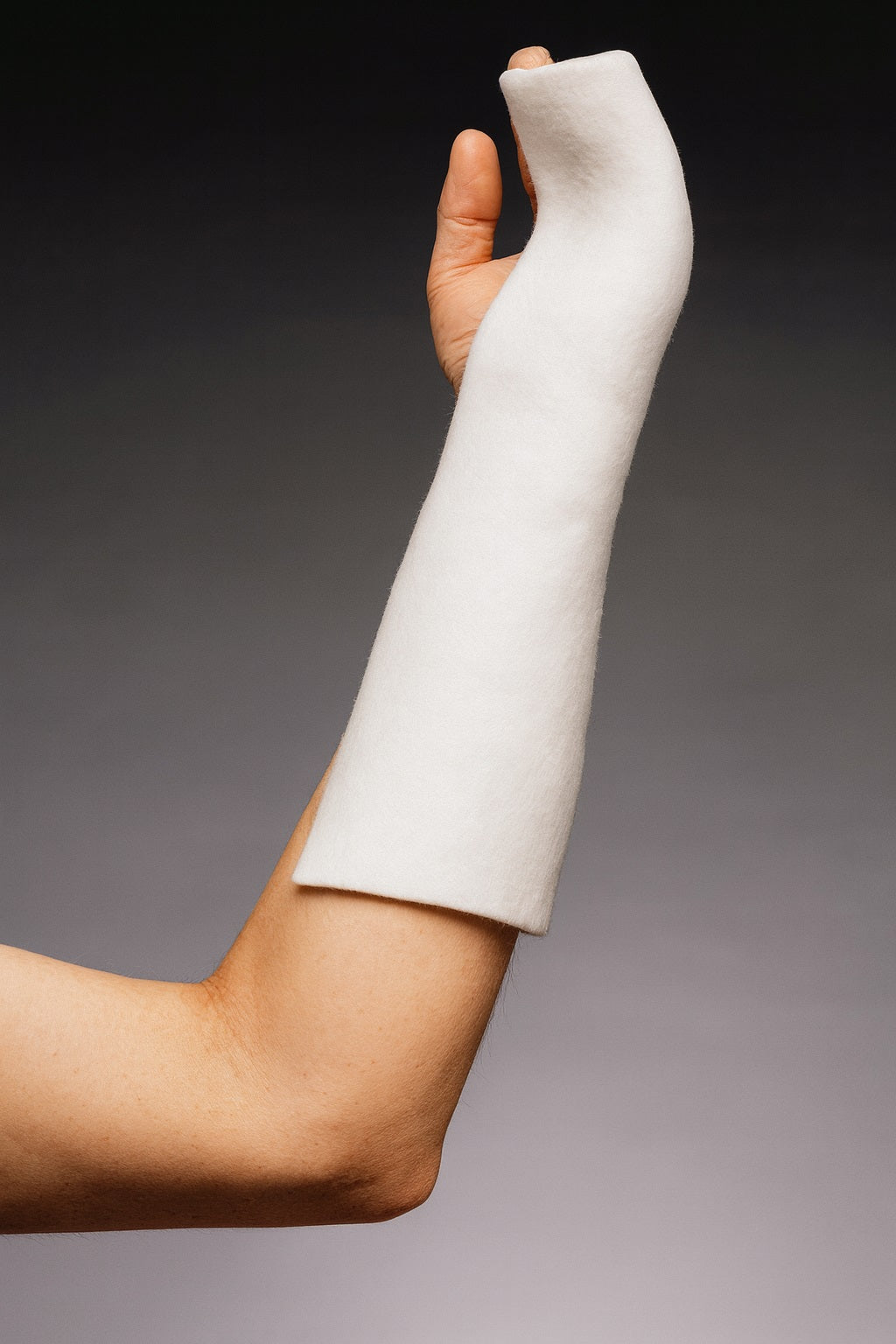
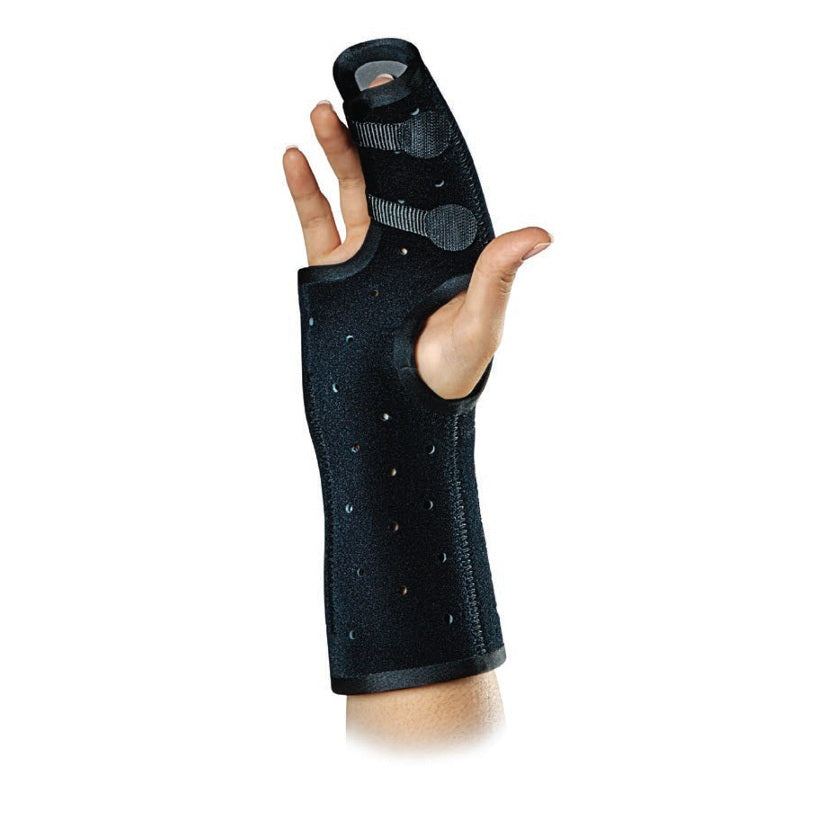
A gutter splint supports one side of the hand and usually includes specific fingers. The goal is to control the injured metacarpals and digits without immobilizing every finger unnecessarily.
Ulnar gutter splint
An ulnar gutter splint runs along the little-finger side of the hand and wrist. It usually supports the fourth and fifth metacarpals and may include the ring and little fingers. It is commonly associated with selected fourth- and fifth-metacarpal fractures, including many injuries described as boxer fractures.
Radial gutter splint
A radial gutter splint supports the thumb-side portion of the hand and generally includes the index and middle fingers. It may be considered for selected second- and third-metacarpal or proximal finger injuries.
Ulnar vs. radial gutter splint
| Feature | Ulnar gutter | Radial gutter |
|---|---|---|
| Side of hand | Little-finger side | Thumb side |
| Digits commonly included | Ring and little fingers | Index and middle fingers |
| Metacarpals commonly protected | Fourth and fifth | Second and third |
| Common search term | Boxer-fracture splint | Index/middle metacarpal splint |
See the Ulnar Gutter Boxer-Fracture Splint Kit, the waterproof thermoformable EXOS Boxer's Fracture Brace, and the EXOS Radial Gutter Fracture Brace.
Posterior Long Arm Splints
A posterior long arm splint is not a wrist-only splint. It extends from the upper arm, across the back of the elbow and down the forearm. Its main purpose is to limit elbow flexion and extension while supporting the forearm and wrist area.
A clinician may select a long arm posterior splint for certain elbow fractures, elbow dislocations, forearm injuries or postoperative plans. It is more restrictive than a short wrist splint and is used when the elbow must be included in the immobilization plan.

See OrthoTape's Posterior Elbow Long Arm Splint Kit.
Which Splint Is Used for Different Wrist and Hand Injuries?
The following table explains common associations, not personal treatment recommendations. The same diagnosis can require a different splint, cast, brace or surgery depending on alignment, stability, swelling and clinician judgment.
| Injury or clinical situation | Splint commonly considered | Why it may be chosen |
|---|---|---|
| Distal radius or Colles' fracture | Sugar tong, volar-dorsal or another clinician-selected wrist/forearm splint | Supports the wrist while accommodating swelling; sugar tong adds forearm rotational control |
| Selected stable wrist sprain | Volar wrist splint or removable wrist brace | Limits painful wrist flexion and extension while leaving the elbow and fingers free |
| Suspected scaphoid injury | Thumb spica splint | Supports the radial side of the wrist and includes the thumb |
| Thumb collateral-ligament injury | Thumb spica splint or brace | Restricts thumb movement and protects the involved ligament while the injury is evaluated and treated |
| Fourth- or fifth-metacarpal fracture | Ulnar gutter splint | Supports the little-finger side of the hand and the affected metacarpals |
| Second- or third-metacarpal fracture | Radial gutter splint | Supports the index/middle-finger side of the hand |
| Selected elbow fracture or dislocation | Posterior long arm splint | Includes the elbow and limits flexion and extension |
| Selected radius or ulna shaft injury | Sugar tong or long arm configuration | Provides more forearm and rotational control than a short wrist splint |
For broader product guidance, visit OrthoTape's Wrist Sprain and Fracture page and Thumb Sprain and Finger Fracture page.
Wrist Splint vs. Cast vs. Brace
A splint, cast and brace can all reduce movement, but they are not interchangeable. The correct level of immobilization depends on the diagnosis and stage of treatment.
| Support type | Construction | Main advantage | Main limitation |
|---|---|---|---|
| Splint | Rigid or semi-rigid support that does not completely encircle the limb | Can accommodate early swelling and permits easier skin and swelling checks | Usually provides less complete circumferential immobilization than a cast |
| Cast | Custom-molded rigid material that encircles the injured area | Consistent circumferential immobilization and protection | Less forgiving of swelling and requires professional removal |
| Removable brace | Prefabricated or thermoformable device with straps or closures | Adjustable and may be removable for approved hygiene or rehabilitation | Can be removed too often, fitted incorrectly or provide insufficient control for some injuries |
Fresh injuries are often splinted first because swelling can increase during the first several days. A clinician may later transition the patient to a cast, a different splint or a removable brace. Read the companion guide to Types of Casts for Broken Bones.
Fiberglass vs. Plaster Wrist and Hand Splints
Wrist and hand splints can be made from plaster, fiberglass, thermoformable plastic or prefabricated brace materials. Plaster and fiberglass remain common for clinician-molded acute splints.
| Material | Advantages | Tradeoffs | Common use |
|---|---|---|---|
| Fiberglass splint | Lightweight, durable, fast-setting and radiolucent | Shorter working time and typically higher material cost than basic plaster | Fast clinical application, durable temporary immobilization and complete pre-padded kits |
| Plaster splint | Excellent moldability, economical and generally provides more working time | Heavier, slower to dry and less resistant to moisture and impact | Detailed molding, traditional emergency splinting and training programs |
| Thermoformable brace | Can be molded and, in some systems, adjusted as swelling changes | Requires correct heating, fitting and product-specific training | Selected fracture, postoperative and rehabilitation protocols |
| Soft or semi-rigid brace | Lower profile, adjustable and easier to remove when permitted | Does not provide the rigid immobilization required for many fractures | Selected sprains, chronic conditions and transition from rigid immobilization |
Water exposure: Do not assume a fiberglass splint is waterproof. Many splints contain absorbent padding and securing bandages that should remain dry. Only expose a splint or brace to water when the manufacturer and treating clinician specifically permit it.
Shop Wrist, Hand and Forearm Splints
OrthoTape supplies professional fiberglass splint kits, removable braces and thermoformable fracture supports. Rigid splints and moldable fracture braces should be selected and applied by a trained healthcare professional or under medical supervision.
U-shaped pre-padded fiberglass system for clinician-directed wrist and forearm immobilization with rotational control.
View Sugar Tong Kit
Palm-side rigid support for selected wrist fractures, sprains and postoperative immobilization.
View Volar Wrist Kit
Two-sided non-circumferential support for stronger wrist immobilization while allowing swelling observation.
View Volar-Dorsal Kit
Clinician-applied thumb and wrist support for selected scaphoid, thumb and radial-side injuries.
View Thumb Spica Kit
Supports the fourth- and fifth-metacarpal side of the hand with pre-padded fiberglass material.
View Ulnar Gutter Kit
Thermoformable support for selected second- and third-metacarpal injuries, fitted under medical supervision.
View Radial Gutter Brace
Extended posterior fiberglass support for selected elbow and forearm injuries.
View Long Arm Kit
Compare wrist, hand, elbow, ankle, knee and other complete splinting kits in one collection.
Shop All Splint KitsBasic Splint Care and Warning Signs
Follow the instructions from the treating clinician and the specific product manufacturer. General principles include:
- Control swelling. Elevate the injured hand above heart level as directed, especially during the first 24 to 72 hours.
- Move uncovered fingers when permitted. Gentle movement can help limit stiffness and swelling, but do not move joints the clinician told you to immobilize.
- Keep conventional splints dry. Wet padding can irritate the skin, weaken support and create odor.
- Do not insert objects beneath the splint. Scratching tools can injure skin and create an infection risk.
- Do not trim or remold a rigid splint yourself. Contact the treating office if an edge rubs, the splint loosens or the fit changes.
- Check exposed fingers. Monitor color, warmth, sensation, swelling and ability to move as instructed.
Contact the treating office promptly for:
- Increasing pain or pressure that is not relieved by elevation
- New numbness, tingling, burning or stinging
- Fingers that become pale, blue, cold or unusually swollen
- Loss of active finger movement
- A splint that becomes cracked, soft, soaked, foul-smelling or visibly damaged
- Skin irritation, drainage, bleeding or a pressure sore near an edge
See OrthoTape's complete Cast and Splint Care Instructions for additional guidance.
Frequently Asked Questions About Wrist and Hand Splints
What are the main types of wrist splints?
Common wrist splints include volar, dorsal, volar-dorsal, sugar tong and thumb spica designs. Hand-specific options include ulnar gutter and radial gutter splints. A posterior long arm splint may be used when the elbow must also be immobilized.
What is the difference between a sugar tong and volar wrist splint?
A sugar tong splint extends around the elbow and provides greater control of forearm pronation and supination. A volar wrist splint stays below the elbow and primarily limits wrist flexion and extension.
Which wrist splint wraps around the elbow?
A sugar tong splint wraps around the elbow in a U-shaped configuration. This extended design helps limit forearm rotation in addition to supporting the wrist.
What is the difference between a thumb spica and a wrist brace?
A standard wrist brace primarily supports the wrist and may leave the thumb free. A thumb spica extends around the thumb, making it more appropriate when the treatment plan requires thumb or scaphoid protection.
What splint is commonly used for a boxer fracture?
An ulnar gutter splint is commonly associated with selected fourth- and fifth-metacarpal fractures, including many boxer-fracture patterns. X-rays, alignment and fracture stability determine the actual treatment.
What is a radial gutter splint used for?
A radial gutter splint supports the index- and middle-finger side of the hand and may be considered for selected second- and third-metacarpal or proximal finger injuries.
Why is a splint sometimes used before a cast?
A splint does not completely encircle the injured area, so it can better accommodate swelling during the acute phase. A clinician may later apply a cast, change the splint or transition to a brace as swelling and healing progress.
Can a fiberglass wrist splint get wet?
Not unless the specific splint system and its padding are approved for water exposure. Fiberglass may resist water, but conventional padding and bandages can remain wet and irritate the skin.
How tight should a wrist or hand splint feel?
A splint should be secure enough to maintain the prescribed position without causing constriction. Increasing pain, numbness, tingling, cold or discolored fingers, or worsening swelling requires prompt reassessment.
Clinical Sources and Editorial Information
Editorial disclosure: OrthoTape.com is operated by K10 Medical Supply, LLC and sells some of the splints, braces and casting products linked in this guide. This article combines hands-on orthopedic-supply experience with published medical guidance.
Medical information: This guide is educational and does not diagnose an injury or replace care from a physician, orthopedic surgeon, hand specialist, physician assistant, nurse practitioner, emergency clinician or qualified cast technician.
Clinical references:
- American Family Physician: Splints and Casts—Indications and Methods
- NCBI Bookshelf: Wrist Splint
- NCBI Bookshelf: Hand Splint
- MSD Manual Professional: How to Apply a Volar Arm Splint
- American Academy of Orthopaedic Surgeons: Care of Casts and Splints
- American Academy of Orthopaedic Surgeons: Distal Radius Fractures
- American Academy of Orthopaedic Surgeons: Hand Fractures