
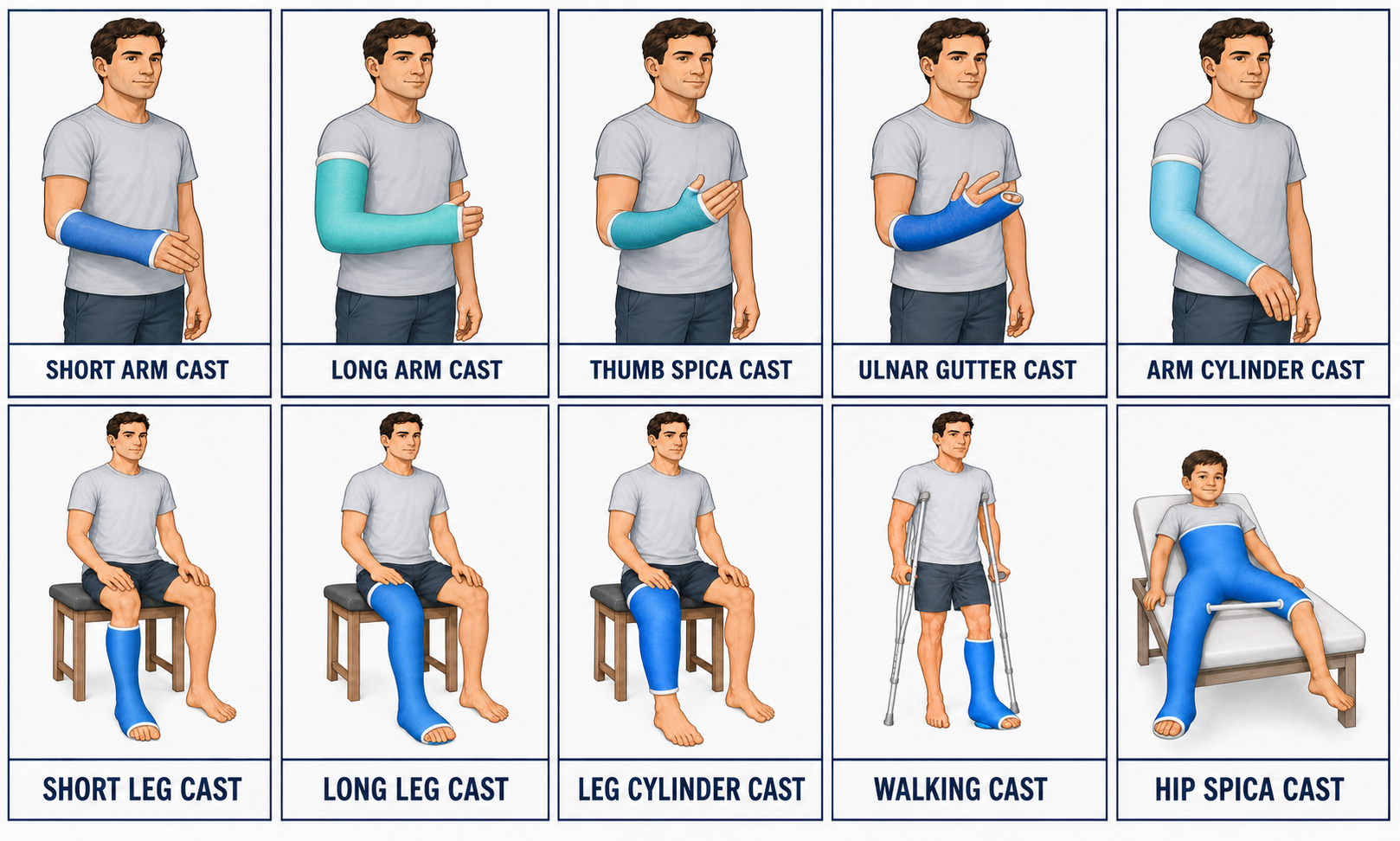
Orthopedic casts are named in two different ways: by the material that forms the hard shell—usually fiberglass or plaster—and by the part of the body they cover, such as a short arm, long arm, short leg or long leg cast. A waterproof cast is usually a fiberglass cast made with a special waterproof liner instead of conventional cotton padding.
Quick answer: What are the main types of casts?
The two main hard-shell materials are fiberglass and plaster. Casts are then described by their coverage: short arm, long arm, thumb spica, short leg, long leg, cylinder, walking and hip spica casts. Waterproof, soft and total-contact casts are specialized variations. The right cast depends on the exact injury, swelling, stability, skin condition and treatment plan—not simply which option feels most comfortable.
Important medical note
A cast should be selected, applied and removed by a qualified healthcare professional. A broken bone may need reduction, surgery, a splint, a brace or a walking boot instead of a cast. Seek urgent care for an open wound over a suspected fracture, severe deformity, a cold or pale hand or foot, loss of movement, new numbness or rapidly worsening pain.
Types of Cast Materials: Fiberglass, Plaster and Waterproof Liners
Most conventional orthopedic casts have three functional layers: a material next to the skin, protective padding or a purpose-made liner, and a rigid outer shell. The outer shell supplies immobilization. The liner and padding protect the skin and influence heat, moisture, drainage and comfort.
This distinction matters because fiberglass itself is water-resistant, but that does not make every fiberglass cast waterproof. If ordinary cotton or synthetic padding becomes soaked, moisture may remain trapped against the skin. A fiberglass cast should only be treated as waterproof when the clinician confirms that the complete cast—including its liner and application method—was designed to get wet.
On mobile, swipe left to view all columns.
| Cast type | Main advantages | Limitations | Common role |
|---|---|---|---|
| Fiberglass cast | Lightweight, strong, fast-setting, available in colors and more radiolucent than plaster | More expensive than basic plaster; conventional padding must remain dry | Common definitive cast for arm, wrist, leg, ankle and foot injuries |
| Plaster cast | Excellent molding and contouring; economical | Heavier, slower to dry, less durable and more easily damaged by water | Situations where precise molding is especially important; splints and early immobilization |
| Waterproof fiberglass cast | Can allow showering, bathing and sometimes swimming when approved; easier rinsing and hygiene | Higher liner cost; not suitable for every injury, wound, surgery or casting stage | Stable injuries and other clinician-approved cases using a complete waterproof liner system |
| Soft or semi-rigid cast | More flexible than a rigid cast; may be easier to remove with the intended technique | Provides less rigid immobilization and is not appropriate for every fracture | Selected stable injuries, serial casting, protection or transition plans |
Fiberglass casts
Fiberglass casting tape contains a knitted fiberglass substrate coated with water-activated resin. Once activated and molded, it hardens into a strong, lightweight shell. Fiberglass is now common because it sets faster, withstands daily wear better and allows clearer follow-up X-rays than plaster. It is also available in many colors.
For clinicians and trained cast technicians, OrthoTape offers fiberglass casting tape in multiple widths and colors, as well as complete fiberglass cast kits sized for common arm and leg casts. These are professional casting materials, not a substitute for diagnosis or proper application.
Plaster casts
Plaster of Paris remains useful because it conforms closely and can be molded precisely around body contours. It is often used for splints and may be chosen when a clinician wants especially detailed molding. Its tradeoffs are extra weight, a longer drying period and lower resistance to water and impact.
Waterproof casts and swim casts
A waterproof cast—sometimes called a swim cast—normally combines a fiberglass outer shell with a waterproof undercast liner. The liner allows water to pass through, drain and dry without saturating conventional cotton padding. Published studies of selected patients have reported high satisfaction and generally favorable skin outcomes, but a waterproof liner does not make every fracture or wound appropriate for water exposure.
OrthoTape’s experience supplying cast materials since 2005 has shown that this is the most commonly misunderstood part of casting: the shell and liner are separate choices. Ask the treating orthopedic office whether a waterproof liner is appropriate and whether it will apply a liner supplied by the patient. Do not wet an existing cast unless the clinician has specifically confirmed that it is waterproof.
Compare OrthoH2O, AquaCast and Delta Dry waterproof cast materials, or read the detailed guide to how waterproof casts work and how to care for them.
Types of Arm Casts
Arm casts are described by how far they extend and which joints they control. A longer cast is not automatically “better.” It restricts more motion, which can be necessary for stability but also creates more bulk and stiffness. The clinician chooses the shortest cast that safely controls the injury.
On mobile, swipe left to view all columns.
| Arm cast | Coverage | Commonly considered for | Motion controlled |
|---|---|---|---|
|
Short arm cast
|
Below the elbow to the hand | Many stable wrist and distal forearm fractures; selected hand injuries | Wrist and part of the forearm while leaving the elbow free |
|
Long arm cast
|
Upper arm to the hand | Elbow, forearm or more unstable wrist-area injuries; certain postoperative plans | Elbow motion and forearm rotation in addition to the wrist |
|
Thumb spica cast
|
Forearm and wrist with support around the thumb | Scaphoid fractures and selected thumb injuries | Wrist and thumb while usually leaving other fingers free |
|
Ulnar gutter cast
|
Forearm along the small-finger side, usually including the ring and little fingers | Selected fourth- and fifth-metacarpal or finger injuries | Small-finger side of the hand and wrist |
|
Arm cylinder cast
|
Upper arm to the wrist | Selected elbow injuries, dislocations or postoperative protection | Elbow motion while leaving the wrist and hand more available |


Short arm versus long arm cast: A short arm cast is less restrictive and leaves the elbow free. A long arm cast adds control of the elbow and forearm rotation. The choice depends on fracture location, alignment and stability, not just where the pain is felt.
Types of Leg Casts
Leg casts may immobilize the foot and ankle, the knee, or nearly the entire leg. Weight-bearing is a separate medical instruction. The term “walking cast” does not mean that every patient with that cast may immediately place full weight on the injured leg.
On mobile, swipe left to view all columns.
| Leg cast | Coverage | Commonly considered for | Key point |
|---|---|---|---|
|
Short leg cast
|
Below the knee through the foot | Selected ankle, lower-leg, foot and Achilles-area injuries | Controls the ankle and foot while allowing knee motion |
|
Long leg cast
|
Upper thigh through the foot | Selected knee, tibia, lower-leg or unstable injuries requiring greater control | Restricts knee and ankle motion and limits leg rotation |
|
Leg cylinder cast
|
Upper thigh to the ankle | Selected knee injuries, dislocations or postoperative plans | Controls the knee while leaving the foot and ankle outside the cast |
|
Walking cast
|
Usually a reinforced short leg cast with a cast shoe, sole or walking heel | Injuries for which the clinician permits protected weight-bearing | Do not walk until specifically cleared and the cast is fully hardened |
|
Hip spica cast
|
Trunk and one or both legs | Certain pediatric hip or femur conditions, fractures and postoperative plans | Specialized cast requiring detailed positioning, skin and hygiene instructions |


For a detailed comparison of non-removable and removable lower-leg support, read walking cast heel vs. walking boot and walking boot vs. cast.
Specialty Casts and Other Casting Methods
Soft and semi-rigid casts
Soft casting materials harden with some flexibility rather than forming the fully rigid shell of ordinary fiberglass. Clinicians may use them for selected stable injuries, protective applications, serial casting or a transition in treatment. “Soft” does not mean self-treatment or unrestricted removal; application and removal should follow the specific product and medical plan.
Serial casts
Serial casting uses a sequence of casts, changed at planned intervals, to gradually improve joint position or soft-tissue range. It is often associated with pediatric or rehabilitation care rather than a single broken-bone cast.
Total contact casts
A total contact cast is closely molded around the lower leg and foot to redistribute pressure. It is widely associated with off-loading certain diabetic or neuropathic foot ulcers and requires specialized wound assessment and monitoring. It is not simply a standard short leg cast applied more tightly.
Body and spica casts
Body, shoulder spica, hip spica and related casts immobilize part of the trunk together with an arm or leg. These are specialized applications generally used for selected pediatric conditions, major injuries or postoperative care.
Which Type of Cast Is Used for Different Broken Bones?
The table below shows common possibilities, not a prescription. Fractures in the same bone may need different treatment depending on displacement, joint involvement, growth plates, soft-tissue injury, swelling, age and whether surgery was performed.
On mobile, swipe left to view all columns.
| Injury area | Cast or support commonly considered | Why treatment may differ |
|---|---|---|
| Broken wrist | Short arm cast; sometimes a long arm cast or splint | Fracture stability, reduction and need to control forearm rotation |
| Broken forearm | Long arm cast or splint; surgery is common for some adult shaft fractures | One or both bones, patient age, angulation and displacement |
| Scaphoid or thumb-area injury | Thumb spica cast or splint | Fracture location, blood supply, visibility on imaging and stability |
| Broken ankle | Short leg splint or cast; sometimes a tall walking boot or surgery | Number of bones involved, displacement and ankle stability |
| Broken foot or metatarsal | Short leg cast, cast shoe, stiff-soled shoe or walking boot | Exact bone and fracture zone, displacement and weight-bearing plan |
| Tibia or fibula fracture | Long leg or short leg cast, tall walking boot, or surgery | Fracture level, alignment, open versus closed injury and ankle or knee involvement |
| Pediatric femur or hip condition | Hip spica cast in selected cases | Age, fracture pattern, hip stability and surgical plan |
Cast vs. Splint vs. Walking Boot
A cast wraps completely around the injured area and generally provides the most consistent immobilization. A splint, sometimes called a half-cast, is not fully circumferential and can better accommodate early swelling. A walking boot is a prefabricated, removable device that can provide substantial support while allowing fit adjustments and, when approved, removal for hygiene or rehabilitation.
On mobile, swipe left to view all columns.
| Support | Main benefit | Main tradeoff |
|---|---|---|
| Cast | Custom-molded, non-removable immobilization and protection | Less forgiving of swelling; requires professional removal |
| Splint | Accommodates swelling and is fast to apply | Usually provides less complete immobilization than a full cast |
| Walking boot | Adjustable and removable when the treatment plan allows | Can be removed too often or fitted incorrectly; not equivalent to a cast for every injury |
Fresh injuries are often splinted first because swelling may increase during the first few days. A full cast may be applied later, or a cast may be cut and overwrapped to allow for swelling. Treatment can also progress from a cast to a splint or brace as healing advances.
Basic Cast Care and Warning Signs
Follow the instructions from the treating office because care differs by cast material, injury and weight-bearing status. General cast-care principles include:
- Control early swelling. Elevate the injured arm or leg as directed, especially during the first 24 to 72 hours, and gently move uncovered fingers or toes if permitted.
- Keep a conventional cast dry. Do not assume fiberglass means waterproof. Damp padding can irritate skin and may require the cast to be checked or replaced.
- Use a waterproof cast only as instructed. Rinse away soap, chlorine or debris as directed, let water drain thoroughly and use only approved drying methods. A hair dryer should be on a cool setting, never hot.
- Do not insert objects. Coat hangers, rulers and other objects can injure skin beneath the cast and create an infection risk.
- Do not alter or remove the cast yourself. Do not trim, break edges, pull out padding or attempt removal unless the clinician has provided instructions for that exact device.
- Protect a walking cast. Use the prescribed cast shoe, heel or sole and do not bear weight until the clinician permits it and the cast is fully hardened.
Contact the treating office promptly for:
- Increasing pain or a cast that feels too tight
- New numbness, tingling, burning or stinging
- Fingers or toes that become pale, blue, cold or unusually swollen
- Loss of active finger or toe movement
- A cracked cast, soft spot, foul odor, drainage or persistent wetness
- Skin that becomes raw, blistered or increasingly painful near the cast edge
See OrthoTape’s complete cast care instructions for additional guidance.
Frequently Asked Questions About Types of Casts
What are the main types of casts for broken bones?
The two main hard-shell materials are fiberglass and plaster. Casts are also named by the area they cover, including short arm, long arm, thumb spica, short leg, long leg, cylinder, walking and hip spica casts. Waterproof and soft casts are specialized variations.
Is fiberglass better than plaster for a cast?
Fiberglass is lighter, stronger, faster-setting and easier to see through on X-rays. Plaster is less expensive and can provide excellent molding for certain injuries. Neither is best in every situation; the clinician chooses based on the injury and application needs.
Can a fiberglass cast get wet?
Not unless the complete cast was applied with a waterproof liner and the treating clinician approved water exposure. The fiberglass shell resists water, but ordinary cotton or synthetic padding underneath can stay wet and irritate the skin.
Can you swim with a waterproof cast?
Some waterproof fiberglass casts allow swimming when the treating clinician and liner instructions permit it. The cast should be rinsed and drained as directed after pool, saltwater or soapy-water exposure. Waterproof casts are not suitable for every fracture, wound or stage of healing.
What type of cast is used for a broken wrist?
Many stable wrist fractures are treated with a short arm cast. A long arm cast may be used when greater control of forearm rotation or the elbow is needed. Some fractures require a splint first, reduction, surgery or another treatment.
What type of cast is used for a broken ankle?
A short leg splint or cast is commonly considered for selected ankle fractures. A walking boot, long leg cast or surgery may be needed depending on displacement, the bones involved and ankle stability.
What is the difference between a short arm and long arm cast?
A short arm cast ends below the elbow and mainly controls the wrist and distal forearm. A long arm cast extends above the elbow, adding control of elbow motion and forearm rotation.
What is the difference between a short leg and long leg cast?
A short leg cast ends below the knee and controls the ankle and foot. A long leg cast extends to the upper thigh and also restricts knee motion and leg rotation.
How long do you wear a cast for a broken bone?
Cast time varies from a few weeks to several months depending on the bone, fracture pattern, age, healing on follow-up imaging and whether surgery was performed. Pain often improves before the bone is ready for normal stress, so the cast should not be removed early without medical approval.
Can you walk on a leg cast?
Only when the treating clinician has approved weight-bearing and provided the proper cast shoe, sole or walking heel. A patient may still need crutches or a walker. Never walk on a cast before it has fully hardened.
Why is a splint sometimes used before a cast?
A splint does not wrap completely around the injured area, so it can better accommodate swelling during the first days after an injury. A full cast may replace it once swelling decreases and the injury has been reassessed.
What symptoms mean a cast may be too tight?
Increasing pain, numbness, tingling, burning, excessive swelling, cold or discolored fingers or toes, and loss of active movement can signal excessive pressure or impaired circulation. Contact the treating office immediately for instructions; loss of movement or circulation requires urgent evaluation.
Shop Cast Kits for Arm and Leg Casts
Standard fiberglass cast kits include fiberglass tape, conventional padding, stockinette and gloves. The finished cast must remain dry.
OrthoH2O waterproof cast kits include waterproof stockinette and fiberglass tape. A clinician must confirm that a waterproof cast is appropriate.
Standard Fiberglass Cast Kits
Complete conventional kits for professionally applied arm and leg casts. Choose patient size, stockinette and fiberglass tape color on the product page.


OrthoH2O Waterproof Cast Kits
OrthoH2O is placed beneath the fiberglass during cast application—it is not a removable cast cover. Ask the treating office whether a waterproof liner is appropriate and whether it will apply the kit you bring.


Before ordering
Confirm the correct cast type and patient size with the treating professional, and ask whether the office will apply patient-supplied materials. These are professional casting products and are not intended for unsupervised self-treatment.
About this guide: OrthoTape.com has supplied orthopedic casting materials and medical support products since 2005. Product details were reviewed by Richard Katenhusen, owner of OrthoTape.com. Clinical statements are supported by the references below. Last reviewed July 26, 2026.
Medical information: This guide is educational and does not diagnose an injury or replace care from a physician, orthopedic surgeon, podiatrist, physician assistant, nurse practitioner or qualified cast technician.
Clinical references:
- American Academy of Orthopaedic Surgeons: Care of Casts and Splints
- American Family Physician: Splints and Casts—Indications and Methods
- Stanford Medicine Children’s Health: Cast Types and Care Instructions
- Cleveland Clinic: Casts—Types and Care
- Mayo Clinic: Cast Care—Do’s and Don’ts
- Journal of the Pediatric Orthopaedic Society of North America: Waterproof vs. Standard Casts
- Journal of Children’s Orthopaedics: Waterproof Cast Liners in Pediatric Forearm Fractures