

Walking cast Boot Guide
Short Walking Boot vs. Tall Walking Boot: Which Cast Boot Is Right?
Choosing the correct cast boot begins with the location of the injury. A short walking boot is generally used when an injury is concentrated in the toes, forefoot or metatarsals. A tall walking boot extends above the ankle and usually provides more immobilization for ankle fractures, severe ankle sprains, Achilles injuries and some lower-leg injuries. The correct height depends on the exact injury and your clinician’s treatment plan—not simply which medical boot feels more comfortable.
Quick answer
Choose short for foot-focused injuries; choose tall when the ankle, Achilles tendon or lower leg needs more control. If your prescription only says “CAM boot,” ask the prescriber whether it should be short/low-top or tall/high-top before ordering.
Short vs. Tall Walking Boot: Main Differences
| Feature | Short Walking Boot | Tall Walking Boot |
|---|---|---|
| Other names | Short CAM boot, low-top cast boot, short fracture boot | Tall CAM boot, high-top cast boot, tall fracture boot |
| Coverage | Foot and lower ankle area | Foot, ankle and more of the lower leg |
| Typical use | Toe, forefoot, metatarsal and some midfoot injuries | Ankle fractures, severe sprains, Achilles injuries and some lower-leg injuries |
| Ankle restriction | Less restriction | More restriction and rotational control |
| Weight and bulk | Usually lighter and less bulky | Usually heavier and warmer |
| Calf fit | Less affected by calf circumference | Calf circumference and boot height matter |
CAM Boot, Cast Boot, Fracture Boot or Air Cast: What Do the Names Mean?
Medical walking boots are called many different things. A prescription, hospital discharge sheet and online product page may use different terms for a similar device.
- CAM boot or CAM walker: CAM commonly means controlled ankle motion. The rigid or semi-rigid shell restricts movement while the rocker sole can assist an approved walking gait.
- Walking boot or medical boot: Broad, everyday names for a removable orthopedic boot.
- Cast boot or fracture boot: Common shopper terms for the same removable device. A cast boot is not a traditional molded fiberglass or plaster cast.
- Air cast boot or pneumatic boot: A walking boot with inflatable air cells or a bladder that can improve fit and provide adjustable compression as swelling changes.
- Aircast: Aircast® is also a specific DJO/Enovis brand. Some people use “air cast” more generally when searching for a pneumatic CAM boot.
- Low-top and high-top: Low-top usually means short; high-top usually means tall.
Confused about a removable boot versus a traditional cast? Read our detailed walking boot vs. cast comparison.
What Is a Short Walking Boot Used For?
A short or low-top walking boot concentrates support around the foot while allowing more movement above the ankle than a tall boot. It is commonly prescribed for stable injuries below the ankle when full lower-leg immobilization is unnecessary.
Common short CAM boot uses
- Stable metatarsal fractures
- Toe and forefoot fractures
- Some midfoot injuries
- Post-operative forefoot care, including some bunion procedures
- Soft-tissue injuries below the ankle
Main benefit: A short cast boot is usually lighter, cooler and less cumbersome. Main tradeoff: It does not control the ankle and lower leg as much as a tall boot.
What Is a Tall Walking Boot Used For?
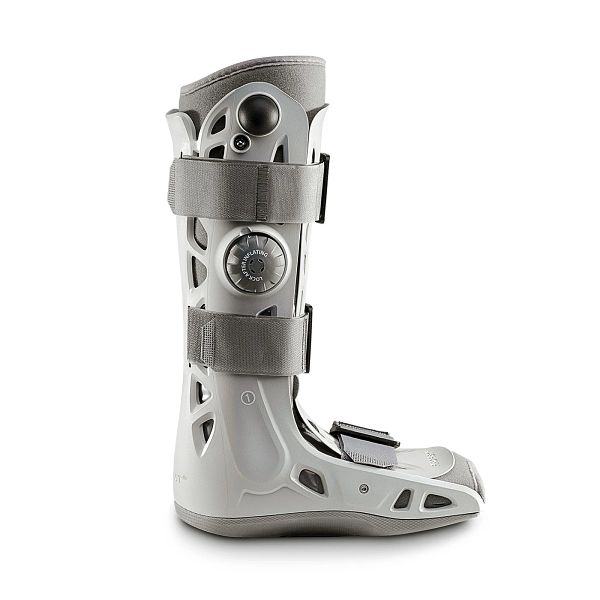
A tall or high-top walking boot extends farther up the lower leg. The longer uprights help reduce ankle motion and provide more leverage against bending and rotation. This added control is why tall boots are commonly selected when the ankle or Achilles tendon is involved.
Common tall CAM boot uses
- Stable ankle fractures
- Grade 2 or Grade 3 ankle sprains when immobilization is prescribed
- Achilles tendon rupture, repair or rehabilitation protocols
- Some stable lower-leg fractures
- Post-operative ankle and lower-leg care
Main benefit: More ankle and lower-leg control. Main tradeoff: More bulk, weight and heat, with fit affected by calf circumference.
Walking Boot Height by Injury Location
This table is a general comparison—not a diagnosis or prescription. Fracture stability, imaging, surgical instructions, swelling, body size and weight-bearing status can change the recommendation.
| Injury or recovery need | More commonly selected | Why |
|---|---|---|
| Toe or forefoot fracture | Short boot | Support is focused below the ankle. |
| Stable metatarsal fracture | Short boot | A lower profile may provide adequate foot immobilization with less bulk. |
| Midfoot or hindfoot injury | Short or tall | The location and stability determine how much ankle control is needed. |
| Stable ankle fracture | Tall boot | Greater ankle immobilization is usually required. |
| Severe ankle sprain | Tall boot or other prescribed immobilizer | The taller shell offers more control across the injured ankle. |
| Achilles rupture or repair | Tall boot with prescribed heel wedges | The ankle position and gradual wedge progression help protect the tendon. |
| Unstable fracture or strict compliance concern | Clinician-selected cast, splint or brace | A removable walking boot may not provide the required protection. |
Broken 5th Metatarsal Walking Boot: Short or Tall?
A broken 5th metatarsal walking boot is often a short boot when the fracture is stable and confined to the foot. However, a fracture at the base of the fifth metatarsal can be an avulsion fracture, Jones fracture or stress fracture, and those injuries do not all heal the same way. Some require strict non-weight-bearing, longer immobilization or surgery. Confirm the fracture location and boot height with the treating clinician.
Broken Fibula Walking Boot: Why Tall Is More Common
A broken fibula walking boot is more commonly a tall, high-top model because the injury is above the foot and may involve the ankle joint or syndesmosis. Fracture height, displacement and ankle stability matter. A boot may be appropriate for some stable fibula fractures, while unstable ankle patterns may require reduction, casting or surgery.
Orthopedic Boot for Foot Stress Fracture
An orthopedic boot for foot stress fracture may be short when the affected bone is in the forefoot or metatarsals. A tall boot may be selected for a higher injury, a hindfoot injury or when greater ankle control is required. Certain stress fractures have a higher risk of delayed healing, so the safest boot and weight-bearing plan depend on imaging and the specific bone involved.
Medical Boot for Broken Foot
A medical boot for broken foot treatment can be short or tall. The words “broken foot” cover many different bones and fracture patterns. A stable toe, forefoot or metatarsal fracture may use a short boot; a midfoot, hindfoot or ankle-adjacent injury may require a tall boot or a non-removable cast.
Air vs. Non-Air Walking Boot
After choosing the correct height, the next decision is usually pneumatic air support versus a standard foam liner.
| Feature | Air/Pneumatic Boot | Non-Air Boot |
|---|---|---|
| Compression | Adjustable as swelling and fit change | Fixed foam padding |
| Best fit | Helpful when edema changes during the day | Straightforward when fit and swelling are stable |
| Complexity | Requires correct inflation; too much air can create pressure | No pump or valve to adjust |
| Cost | Usually higher | Usually lower |
An air bladder improves adjustability; it does not make the wrong boot height appropriate for the injury.
Aircast AirSelect Walking Boot: Short vs. Standard Tall
The Aircast AirSelect walking boot line includes different heights for different injury locations. The Aircast AirSelect Short walker boot is a low-top pneumatic cast boot commonly selected for stable forefoot, metatarsal and midfoot injuries. The Aircast AirSelect Standard walking boot extends above the ankle for greater immobilization in ankle, Achilles and some lower-leg treatment plans.
| AirSelect model | Height | Typical focus |
|---|---|---|
| AirSelect Short | Short/low-top | Forefoot, metatarsal, midfoot and post-operative foot care |
| AirSelect Standard | Tall/high-top | Ankle, Achilles and treatment plans requiring more lower-leg control |
Air Cast Boot Size Chart, Fit and Use
There is no universal Aircast boot size chart for every model. Size ranges differ between Aircast, Össur and DeRoyal boots, so use the chart on the exact product page. Do not assume a medium in one brand matches a medium in another.
1. Size ranges can feel roomy
CAM boots usually cover a range of shoe sizes so they can accommodate swelling, bandages, dressings and socks. Seat your heel fully against the back of the liner before fastening the straps. Use the manufacturer’s size chart rather than ordering from your usual shoe size alone.
2. Measure the calf for a tall boot
A tall boot must close securely around the widest part of the calf without creating painful pressure. People with a larger calf may fit a short boot more easily, but the injury—not calf comfort—determines whether a short boot provides enough immobilization.
3. Match the height of the other shoe
A thick rocker sole can make the injured side feel longer. A supportive shoe or approved shoe-leveling device on the opposite foot may reduce an uneven gait. Ask your clinician or physical therapist what is appropriate.
4. “Walking boot” does not automatically mean you can bear weight
Your prescription should state whether you are non-weight-bearing, partial weight-bearing or weight-bearing as tolerated. Crutches or another mobility aid may still be necessary.
5. How to use an air cast boot
Open the liner and straps, seat the heel fully against the back, close the liner, secure the straps from the foot upward, and then adjust the air cells according to the manufacturer’s instructions. Compression should feel supportive—not painful. Release air and contact the treating clinician if you develop numbness, tingling, discoloration, burning, cold toes or increasing pressure.
Shop Short Walking Boots
Short, low-top CAM boots are generally chosen for foot-focused injuries when less ankle restriction is prescribed.


Shop Tall Walking Boots
Tall, high-top CAM boots extend above the ankle for treatment plans requiring greater ankle and lower-leg immobilization.


Compare Every Medical Cast Boot
See all short, tall, air and non-air walking boots from Össur, Aircast and DeRoyal.
Shop All CAM & Cast BootsWhen a Walking Boot May Not Be Enough
A removable medical boot is not appropriate for every injury. An unstable fracture, significant displacement, an open injury, neurovascular symptoms or a treatment plan requiring strict non-removable immobilization may call for a splint, fiberglass cast, surgery or another clinician-selected device.
Seek prompt medical evaluation for severe deformity, an open wound over a suspected fracture, a cold or pale foot, new numbness, loss of sensation, rapidly increasing swelling, severe calf pain, chest pain or shortness of breath.
Short vs. Tall Walking Boot FAQ
Is a short or tall walking boot better?
Neither is universally better. A short walking boot is lighter and generally suited to foot-focused injuries. A tall walking boot offers greater ankle and lower-leg immobilization. The correct option is the one that matches the diagnosed injury and treatment plan.
Can I use a short walking boot for an ankle fracture?
Do not substitute a short boot unless the treating clinician approves it. An ankle fracture often requires the increased ankle control of a tall boot, cast or another immobilizer.
Can I use a tall walking boot for a metatarsal fracture?
A tall boot can immobilize the foot, but it may provide more ankle restriction and bulk than a stable metatarsal fracture needs. Many foot-focused injuries are treated with a short boot. Follow the height selected by the prescriber.
Does a short CAM boot support the ankle?
A short boot provides some support around the foot and lower ankle, but it generally permits more ankle and lower-leg movement than a tall CAM boot. It should not be assumed to provide equivalent immobilization.
Is an air cast the same as a CAM boot?
An air cast boot is a type of CAM walking boot that uses inflatable air cells or a pneumatic bladder for adjustable compression and fit. Aircast® is also a specific brand sold by DJO/Enovis.
Can I walk in a CAM boot without crutches?
Only if your clinician has approved the appropriate level of weight-bearing. The words “walking boot” describe the device, not your permission to place full weight on the injured foot. Some people still need crutches, a walker or another mobility aid.
Should I sleep in my walking boot?
Wear-at-night instructions depend on the injury, stability and stage of healing. Some treatment plans require the boot at night, while others allow removal. Follow the prescriber’s instructions rather than removing it based only on comfort.
Can I drive while wearing a walking boot?
Driving in a walking boot may delay braking, restrict ankle movement and conflict with medical or insurance restrictions, especially when the right foot is injured. Do not drive until your clinician has cleared you and you can safely control the vehicle.
How should a walking boot fit?
Your heel should sit fully back in the liner, the foot should not slide excessively, and the straps should be snug without numbness, tingling, discoloration or painful pressure. Use both the shoe-size chart and any available foot-length or calf-circumference measurements.
What walking boot is used for a broken fifth metatarsal?
A short walking boot is often selected for a stable fifth metatarsal fracture because the injury is confined to the foot. A Jones fracture or higher-risk stress fracture may require stricter non-weight-bearing, longer immobilization or surgery, so confirm the exact fracture type and treatment plan.
Is a tall walking boot used for a broken fibula?
A tall walking boot is more commonly used for stable fibula fractures because it supports more of the lower leg and ankle. The correct treatment depends on fracture location, displacement and ankle stability; some fibula fractures require a cast or surgery instead.
How do I use an air cast boot?
Seat the heel fully in the back of the liner, secure the straps from the foot upward, and adjust the air cells only as directed for that model. The fit should be supportive without painful pressure, numbness, tingling, cold toes or discoloration.
Product terminology and specifications reviewed by OrthoTape.com. Last reviewed July 24, 2026.
Medical information: This guide is educational and does not diagnose an injury or replace care from a physician, podiatrist, orthopedic surgeon or physical therapist. Use a walking boot only as directed by a qualified healthcare professional.
Clinical and manufacturer references: