
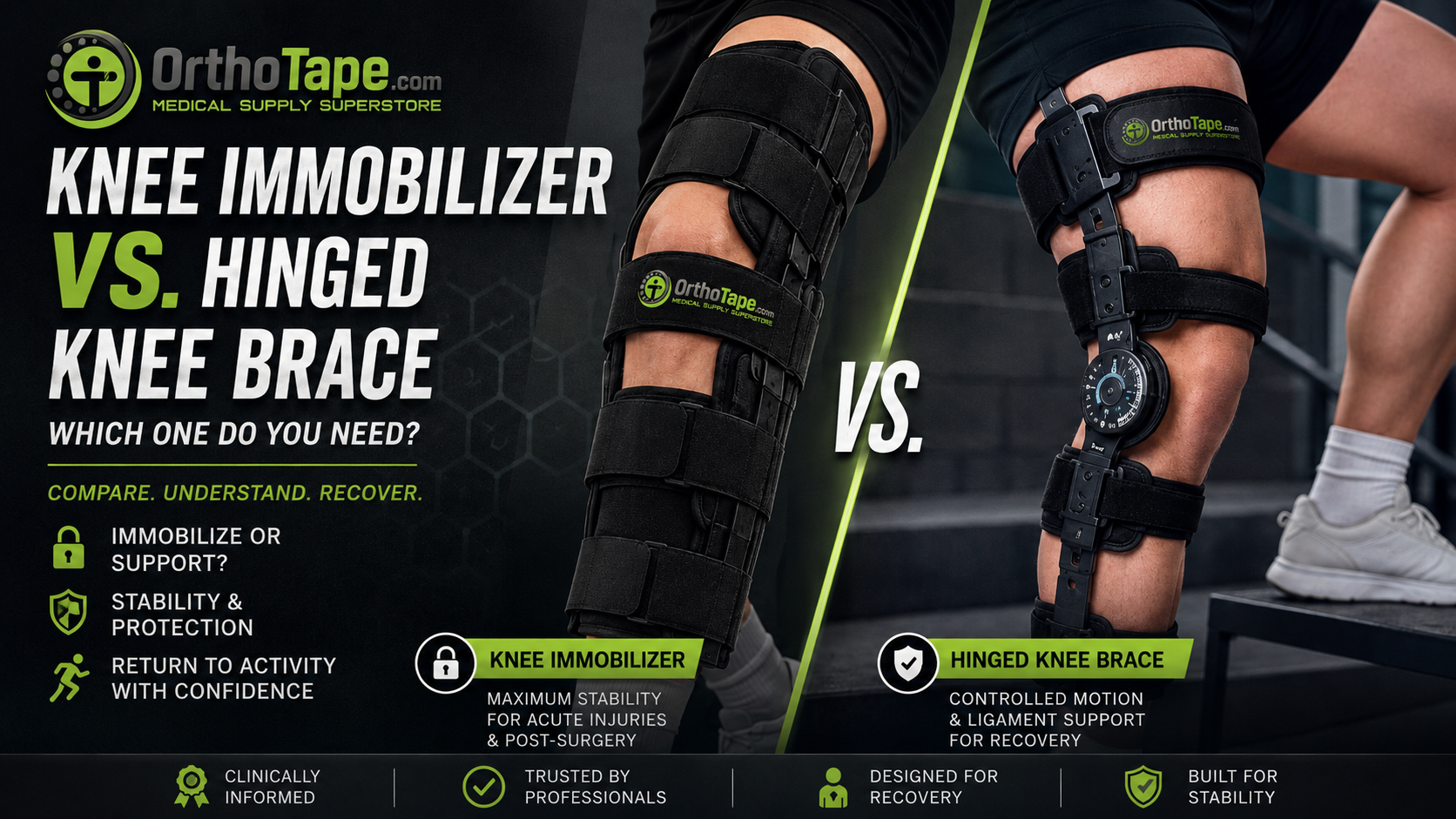
A knee immobilizer and a hinged knee brace are not interchangeable. A knee immobilizer is designed to keep the knee straight and prevent bending. A hinged knee brace supports the joint from both sides while allowing either clinician-controlled motion or more natural movement, depending on the brace design and hinge settings.
Quick answer: Which is better—a knee immobilizer or a hinged knee brace?
A knee immobilizer is usually better when the treatment goal is to stop the knee from bending. A post-operative hinged ROM brace is better when the knee must remain protected while gradually allowing a prescribed amount of flexion and extension. A shorter functional hinged brace is generally used for ligament stability during movement rather than complete immobilization.
Important medical note: Serious knee injuries can involve fractures, ligament tears, tendon ruptures, dislocations, cartilage damage or blood-vessel and nerve injury. Brace selection, hinge settings, weight-bearing status and wearing schedule should come from the treating orthopedic provider. Seek urgent evaluation for major deformity, a locked knee after trauma, inability to perform a straight-leg raise, severe swelling, numbness, a pale or cold foot, or loss of pulses.


Knee Immobilizer vs. Hinged Knee Brace: Key Differences
The most important question is not which brace is “stronger.” It is whether the knee should remain still or move within a controlled range. A rigid immobilizer, a long post-operative ROM brace and a shorter functional ligament brace each solve a different problem.
| Feature | Knee immobilizer | Post-op hinged ROM brace | Functional hinged brace |
|---|---|---|---|
| Primary purpose | Prevent knee bending | Protect the knee while permitting prescribed controlled motion | Support medial and lateral stability during movement |
| Knee motion | Held near full extension | Can usually be locked or limited with adjustable stops | Usually allows functional flexion and extension |
| Typical length | Mid-thigh to mid-calf or longer | Long frame from thigh to lower leg | Shorter brace centered around the knee |
| Common phase of care | Acute protection or immediate post-op immobilization | Post-operative and progressive rehabilitation | Later rehabilitation, daily instability support or return to activity |
| Adjustment | Straps and length or panel positioning | Straps, frame length, lock angle and flexion/extension stops | Straps, sleeve or wrap fit and optional ROM stops on some models |
| Best purchased from | Exact clinician-prescribed design and size | Exact model and settings ordered by surgeon or therapist | Selected by diagnosis, instability pattern, activity and fit |
A hinged brace is not automatically a rehabilitation brace. Some long ROM braces can be locked and used as immobilizers during the earliest stage of recovery. Conversely, a short neoprene hinged brace may provide ligament support but is not intended to replace a full-length immobilizer after a major fracture or surgery.
What Is a Knee Immobilizer?
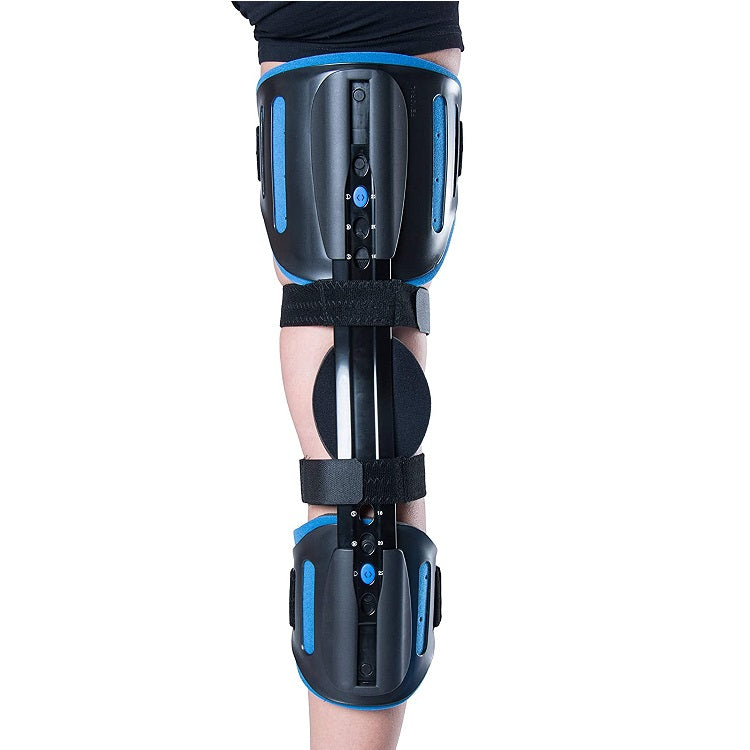
A knee immobilizer is a rigid or semi-rigid orthopedic device that holds the knee in a straight or nearly straight position. Most designs use rigid posterior and side stays, padded thigh and calf panels, and multiple hook-and-loop straps.
The immobilizer reduces flexion and extension while leaving more of the leg accessible than a circumferential cast. It may be used for acute stabilization, selected fractures, tendon injuries, severe sprains, dislocations after reduction or protection after surgery. The exact indication and duration depend on the diagnosis and treatment protocol.
Advantages of a knee immobilizer
- Quick to apply during acute care
- Provides strong restriction of knee flexion and extension
- Can often be opened for skin, wound and swelling checks
- May be removed for approved hygiene or examination
- Available in breathable and padded designs
Limitations of a knee immobilizer
- Does not provide staged range-of-motion progression
- Can make sitting, sleeping, stairs and vehicle entry difficult
- May slide down if improperly sized or strapped
- Extended immobilization can contribute to stiffness and muscle weakness
- Does not determine whether weight-bearing is safe
Browse OrthoTape's Knee Immobilizers or see the Ossur Exoform Knee Immobilizer.
What Is a Posterior Knee Splint?
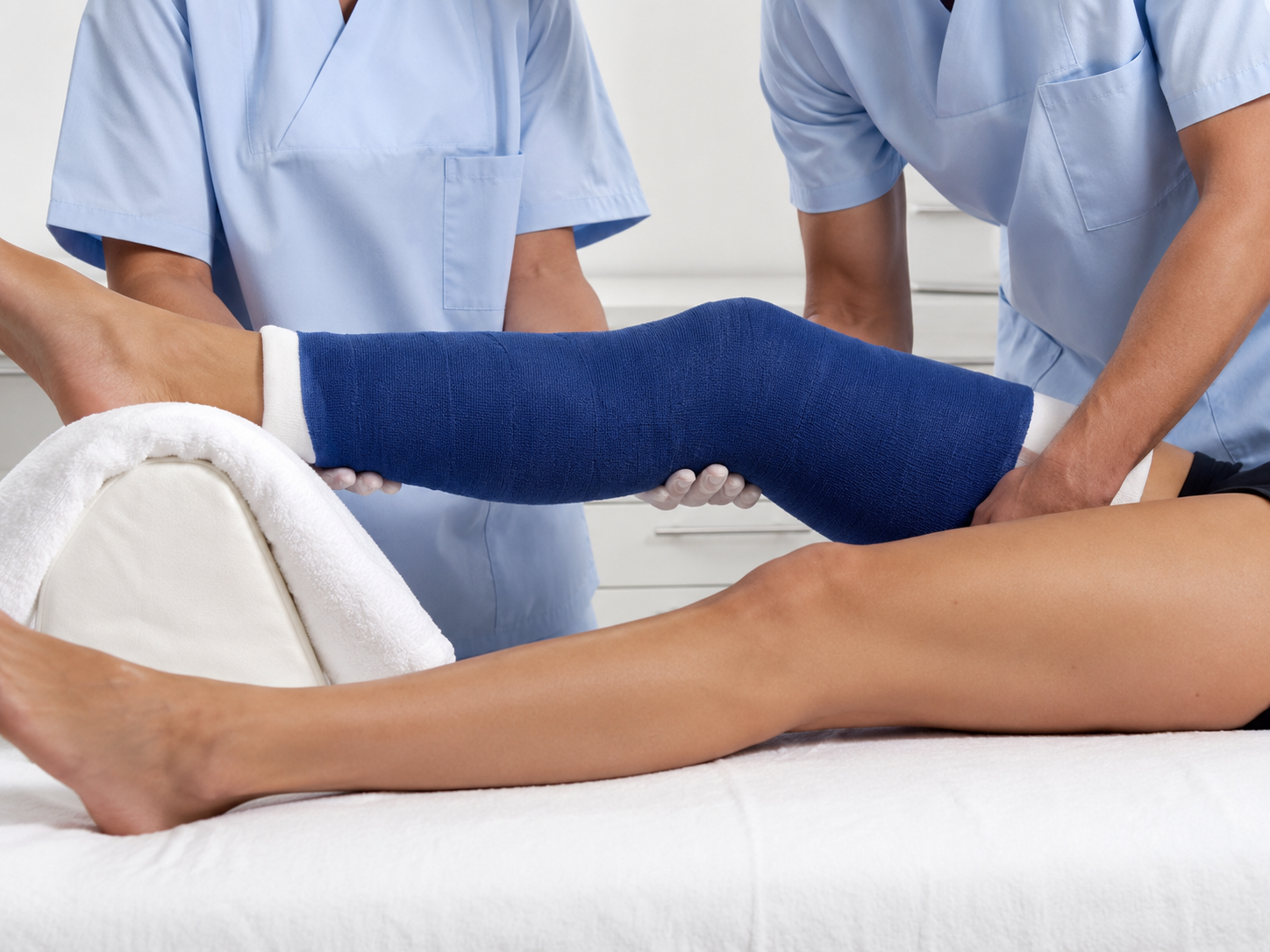
A posterior knee splint is a rigid slab applied along the back of the leg, generally extending from the upper thigh toward the ankle. It is sometimes described as a soft cast, removable half cast or posterior long-leg splint.
Because the splint does not completely encircle the leg, it can leave room for swelling while still restricting knee movement. A posterior splint is normally molded and applied by a trained clinician. It may be selected for acute fractures, dislocations, serious ligament injuries or post-operative protection.
Posterior knee splint vs. removable immobilizer
| Feature | Posterior fiberglass splint | Prefabricated knee immobilizer |
|---|---|---|
| Construction | Custom-molded fiberglass or plaster slab secured with padding and bandages | Prefabricated padded brace with rigid stays and straps |
| Fit | Molded to the individual leg by a clinician | Adjusted using panels, stays, straps and size selection |
| Swelling accommodation | Non-circumferential design can accommodate acute swelling | Straps may be adjusted, but pressure and fit still require monitoring |
| Application | Requires splinting technique and correct molding | Usually faster to fit and reapply |
See OrthoTape's Posterior Knee Splint Kit. The kit is intended for application by a trained medical professional or for professional training.
Post-Operative Hinged ROM Knee Braces
A post-operative ROM knee brace uses long side uprights and adjustable hinges to control flexion and extension. “ROM” means range of motion. The clinician can lock the brace or set limits that determine how far the knee may bend and straighten.
This design can bridge the gap between complete immobilization and unrestricted movement. As healing progresses, the surgeon or physical therapist may change the settings to allow more motion. The brace may be used after ligament reconstruction, meniscus repair, tendon repair, knee replacement, fracture fixation or other procedures when both protection and staged rehabilitation are required.

What ROM settings mean
ROM hinges commonly include separate flexion and extension controls. For example, an extension stop may prevent the knee from straightening beyond a chosen angle, while a flexion stop limits how far the knee can bend. A drop-lock or lock mechanism may hold the brace at a specific position.
Do not change ROM settings without instructions
Hinge settings are part of the treatment plan. Increasing motion too soon can stress healing tissue, while leaving the knee restricted longer than prescribed can delay rehabilitation. Only adjust the stops or locks according to the treating provider's directions.
Compare OrthoTape's Post-Op Hinged ROM Knee Braces.
Functional Hinged Knee Braces for Ligament Support
A functional hinged knee brace is generally shorter and less restrictive than a post-operative ROM brace. It uses medial and lateral hinges to reduce unwanted side-to-side movement while allowing the user to bend and straighten the knee during walking and approved activities.
Functional braces may be prescribed for mild-to-moderate ACL, PCL, MCL or LCL instability, combined ligament problems, hyperextension control or later-stage return to activity. They are not substitutes for acute fracture immobilization or a long post-operative brace when a surgeon has ordered restricted ROM.


Functional brace vs. simple knee sleeve
A basic compression sleeve may provide warmth, compression and proprioceptive feedback, but it does not offer the same rigid medial and lateral support as a true hinged brace. When ligament instability is the concern, the hinge design and strap system matter more than compression alone.
Which Knee Brace Is Used by Injury or Recovery Stage?
The following table describes common clinical patterns, not personal treatment recommendations. The diagnosis, stability, imaging, surgery, swelling and neurovascular examination determine the actual device.
| Situation | Device commonly considered | Treatment goal |
|---|---|---|
| Acute knee trauma before definitive diagnosis | Knee immobilizer, posterior splint or locked post-op brace | Protect the knee and reduce movement while the injury is evaluated |
| Selected patella, distal femur or proximal tibia fracture | Immobilizer, posterior splint or locked hinged brace | Maintain prescribed alignment and protect the fracture |
| Quadriceps or patellar tendon injury | Immobilizer or brace locked in extension | Prevent knee flexion from stressing the extensor mechanism |
| Immediately after ligament reconstruction or meniscus surgery | Post-op hinged ROM brace, often initially locked or limited | Protect the repair while following the surgeon's staged protocol |
| Progressive post-op rehabilitation | Post-op ROM brace with adjusted flexion and extension limits | Restore movement while maintaining protection |
| Mild-to-moderate collateral or cruciate ligament instability | Functional hinged knee brace | Support medial and lateral stability during movement |
| Return to approved work, exercise or sport | Functional hinged brace when prescribed | Provide stability without full immobilization |
Transitioning From Immobilization to Controlled Motion
Many knee-recovery plans move through several phases rather than using one brace from start to finish:
- Acute protection: the knee may be immobilized while swelling, pain, fracture stability or surgical repair is assessed.
- Controlled ROM: a hinged post-op brace may allow a prescribed amount of bending and straightening.
- Strength and gait rehabilitation: motion and weight-bearing may progress under medical and physical-therapy supervision.
- Functional support: a shorter hinged brace may be used during approved daily activity or return to sport.
The progression is not automatic. Some injuries require prolonged protection, while others benefit from earlier controlled motion. AAOS guidance for several knee injuries emphasizes that the treating clinician decides when movement should begin based on tissue healing and stability.
Knee Brace Fit, Sizing and Hinge Alignment
Immobilizer fit
- The brace should provide adequate thigh and calf coverage without pressing into the groin or ankle.
- Rigid stays should remain centered and should not dig into the skin.
- Straps should secure the brace without causing numbness, discoloration or worsening swelling.
Hinged brace fit
- The hinge centers should align with the knee joint line.
- The brace should not rotate or slide down during approved movement.
- Measure at the exact location specified by the manufacturer; different braces use different thigh, calf or leg-length measurements.
- Confirm whether the product is universal, side-specific, contoured, sleeve-style or wraparound.
Contact the treating office promptly for:
- New numbness, tingling, burning or weakness
- A foot that becomes cold, pale, blue or unusually swollen
- Increasing pain or pressure that does not improve with repositioning
- Skin breakdown, blistering, drainage or pressure injury
- A brace that repeatedly unlocks, breaks or cannot maintain the prescribed position
- New calf pain, marked swelling, chest pain or shortness of breath
Shop Knee Immobilizers and Hinged Knee Braces
The products below illustrate the major brace categories discussed in this guide. The main product image is included so you can visualize the design before opening the product page. Purchase the exact type, model and size recommended by the treating clinician.
Rigid adjustable immobilizer that holds the knee in extension for clinician-directed acute and post-operative protection.
View Exoform Immobilizer
Professional fiberglass posterior leg splint kit for clinician-applied rigid knee and leg immobilization.
View Knee Splint Kit
Long post-operative hinged brace with adjustable range-of-motion controls for staged rehabilitation.
View Ossur Rebound
Universal post-operative brace with drop-lock settings and adjustable ROM hinges for progressive recovery.
View Warrior Recovery
Functional hinged brace for clinician-directed ACL, PCL, MCL and LCL instability support.
View Warrior II
Breathable functional ligament brace that supports the knee while allowing natural movement.
View Playmaker II
Affordable wraparound hinged support for mild-to-moderate instability and everyday knee support.
View eLife Hinged BraceBrowse all Knee Braces and Supports, Knee Immobilizers, Post-Op ROM Braces and Knee Ligament Braces.
Frequently Asked Questions
What is the difference between a knee immobilizer and a hinged knee brace?
A knee immobilizer is designed to hold the knee straight and prevent bending. A hinged knee brace supports the joint from both sides while allowing either prescribed controlled motion or a more natural range of motion, depending on the brace type and settings.
Can a hinged knee brace also immobilize the knee?
Some post-operative ROM hinged braces can be locked at a prescribed angle, including full extension. Functional hinged braces are generally designed for stability during movement and may not provide the same immobilization as a rigid immobilizer.
Which brace is used immediately after a serious knee injury?
A clinician may use a knee immobilizer, posterior knee splint or locked post-operative ROM brace for acute protection. The selection depends on the diagnosis, swelling, stability, surgical plan and neurovascular findings.
Which knee brace is used during rehabilitation?
A post-operative ROM brace may be used when the clinician wants to allow a controlled amount of bending and straightening. A shorter functional hinged brace may be used later for ligament support during daily activity or return to sport.
Can I walk in a knee immobilizer?
Walking and weight-bearing depend on the injury and the treating clinician's orders. Some patients may walk with the knee held in extension and use crutches or a walker, while others must remain non-weight-bearing.
Should I adjust the hinge settings myself?
No. Range-of-motion stops and lock settings should be changed only according to the orthopedic surgeon's, physician's or physical therapist's instructions.
Why does my knee brace slide down?
Migration can result from incorrect sizing, loose straps, poor hinge alignment, swelling changes, clothing under the brace or worn padding. Recheck the fitting instructions and contact the treating office if the brace will not stay positioned.
Can prolonged knee immobilization cause stiffness?
Extended immobilization can contribute to knee stiffness and muscle weakness. The treating clinician determines when protection can be reduced and controlled motion or physical therapy can safely begin.
Clinical Sources and Editorial Information
Editorial disclosure: OrthoTape.com is operated by K10 Medical Supply, LLC and sells some of the knee immobilizers, hinged braces and splinting products linked in this guide.
Medical information: This article is educational and does not diagnose an injury or replace evaluation and instructions from an orthopedic surgeon, physician, physician assistant, nurse practitioner, physical therapist or other qualified clinician.
Clinical references: