
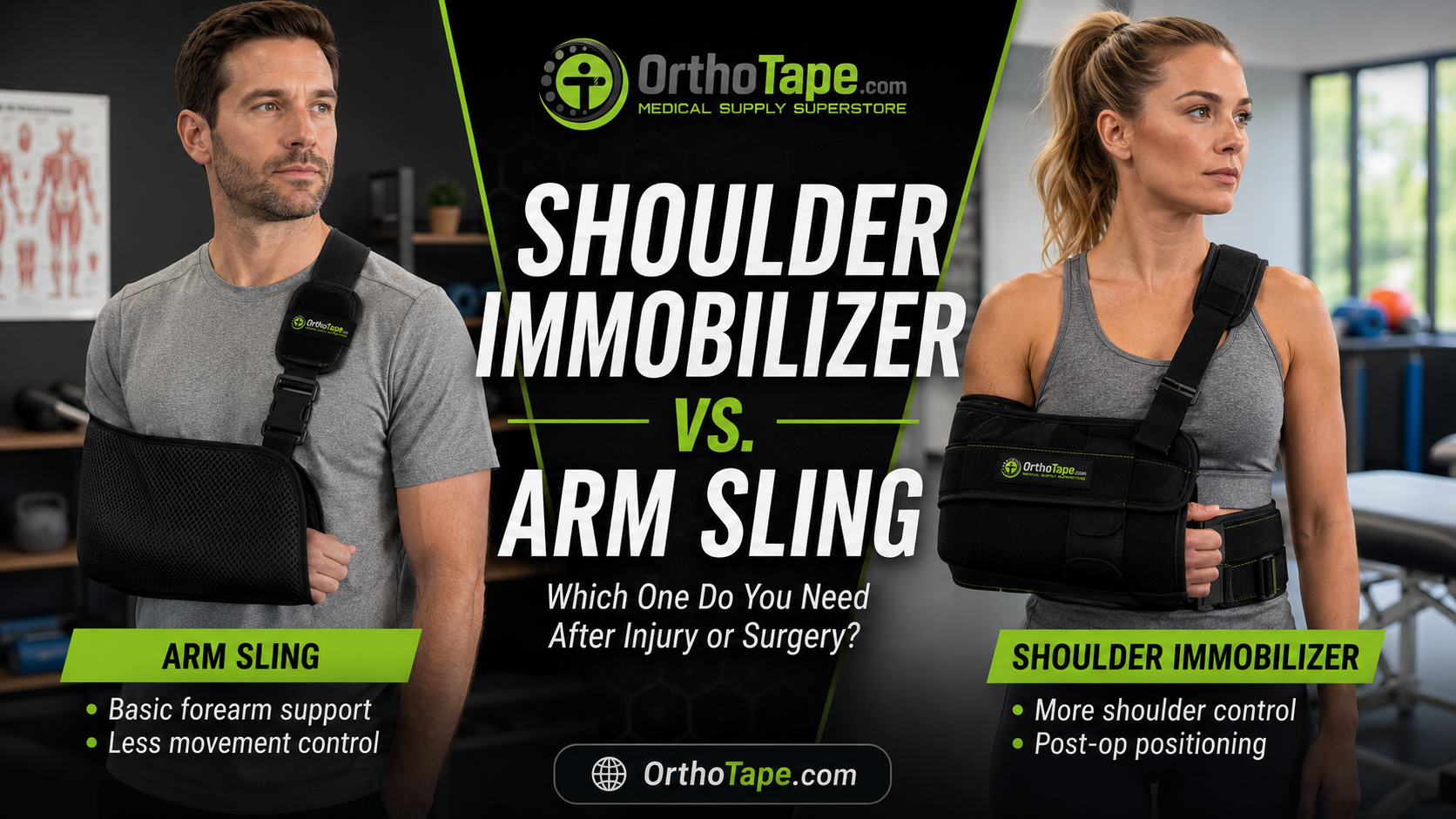
Shoulder Immobilizer vs. Arm Sling: Which One Do You Need After Injury or Surgery?
An arm sling, shoulder immobilizer and abduction-pillow sling can look similar, but they do not provide the same level of control. The correct device depends on whether the goal is simple forearm support, stronger restriction of shoulder movement or a precisely prescribed post-operative arm position.

ARM SLING: forearm support in a neutral position

ABDUCTION IMMOBILIZER: prescribed arm positioning after injury or surgery
Arm Sling vs. Shoulder Immobilizer vs. Abduction Sling
Arm sling
A basic arm sling supports the elbow and forearm so the weight of the arm does not pull as heavily on the injured shoulder. It is commonly used when the clinician wants support without a large positioning pillow or rigid frame.
Typical design: a forearm pouch with a padded strap routed around the neck or opposite shoulder.
Shoulder immobilizer
A shoulder immobilizer usually combines a sling with a stabilizing strap, body swathe or waist belt. This helps keep the upper arm closer to the torso and reduces unintended shoulder movement.
Typical design: sling plus a torso-control strap or secure body attachment.
Abduction-pillow sling
An abduction-pillow sling places a shaped cushion between the arm and torso. This holds the shoulder away from the body at a prescribed angle and may reduce tension on selected repaired tissues.
Typical design: immobilizing sling, waist strap and rigid or semi-rigid positioning pillow.
The American Academy of Orthopaedic Surgeons notes that patients may need a sling or special immobilizer after shoulder arthroscopy, and the surgeon determines how long it is required. Review the AAOS shoulder arthroscopy guidance.
Comparison Table: Which Design Does What?
| Feature | Basic Arm Sling | Shoulder Immobilizer | Abduction-Pillow Sling | Rigid Abduction Brace |
|---|---|---|---|---|
| Main purpose | Support the forearm and reduce downward pull | Support the arm while limiting more shoulder movement | Protect the shoulder in a prescribed abducted position | Provide structured, diagnosis-specific positioning |
| Arm position | Usually close to the torso | Usually close to the torso with stronger control | Away from the torso by the pillow angle | May allow specified abduction and rotation settings |
| Common components | Forearm pouch and shoulder strap | Sling plus body swathe, torso strap or waist belt | Sling, pillow and waist strap | Frame, hinge, sling and positioning pads |
| Common clinical use | General support after selected injuries or procedures | Greater protection after injury, dislocation or surgery | Rotator cuff, labrum or other procedures requiring abduction | Repairs requiring a more exact prescribed position |
| Can the patient choose the angle? | Not usually angle-based | No—follow the prescribed position | No—the clinician selects the configuration | No—angles and settings require clinical direction |
What a Basic Arm Sling Does
A sling supports the elbow and forearm. This can reduce discomfort from the unsupported weight of the arm and remind the patient not to use the injured shoulder. However, a sling alone may still permit the upper arm to move away from the torso, rotate or shift during sleep and daily activity.
The sling-only configuration of the Ossur Formfit Shoulder Brace uses a breathable forearm pouch and adjustable padded straps. The same product page also offers abduction and external-rotation configurations, allowing the prescribed setup to match the recovery plan.
What Makes a Shoulder Immobilizer Different?
A shoulder immobilizer adds a second layer of control. Depending on the design, a stabilizing strap, body swathe or waist belt helps keep the upper arm from drifting away from the torso. This is useful when simple forearm support is not enough to protect the injured or repaired shoulder.
AAOS guidance for shoulder trauma describes immobilization with a sling or shoulder immobilizer as part of nonsurgical care for some shoulder fractures and dislocations. Read the AAOS shoulder trauma overview.
Why Some Slings Have an Abduction Pillow
Abduction means positioning the arm away from the side of the body. In selected shoulder-repair protocols, a pillow is used to maintain this position and reduce stress on the repaired area. The correct angle depends on the procedure and surgeon's protocol.
Massachusetts General Hospital rotator cuff rehabilitation protocols include sling use with an abduction pillow in the early post-operative phase for certain repairs. These protocols also emphasize that movement restrictions and progression are procedure-specific. View the Mass General rotator cuff rehabilitation protocol.

When a Rigid Shoulder Abduction Brace May Be Prescribed
A rigid shoulder abduction brace is more structured than a soft sling and pillow. The DeRoyal Warrior Wing Shoulder Abduction Immobilizer Brace uses an aluminum waist frame, an airplane-style hinge and multiple positioning pillows. It is designed for diagnosis-specific positioning after procedures such as rotator cuff, Bankart or SLAP repair when the treating clinician requires controlled abduction or rotation.


Common Situations and the Device a Clinician May Consider
Rotator cuff repair
A post-operative shoulder immobilizer with an abduction pillow is commonly used in many rotator cuff protocols. The pillow angle, duration and permitted exercises vary according to tear size, repair method and surgeon preference.
Labrum or instability surgery
Bankart, SLAP and other instability procedures may require a neutral, abducted or externally rotated position. These configurations are not interchangeable, so the brace must match the surgeon's specific order.
Shoulder dislocation
A sling or immobilizer may be used after reduction to protect the injured joint. The required position and duration depend on the direction of the dislocation, age, recurrence risk and associated injuries.
Shoulder fracture
Selected clavicle, proximal humerus or scapular fractures may be managed with a sling or immobilizer. Fracture pattern, displacement and stability determine whether nonsurgical support is appropriate.
Minor sprain or temporary support
A clinician may choose a less restrictive sling when the primary need is support and comfort rather than precise post-operative positioning. Persistent pain, deformity, weakness, numbness or inability to raise the arm warrants medical evaluation.
How to Fit a Shoulder Sling or Immobilizer
The exact fitting sequence varies by brand and configuration. Use the manufacturer's instructions and the treating clinician's prescribed angle. These general checks help identify common fitting problems.
- Confirm the prescribed configuration. Verify the correct side, sling size, pillow or brace configuration, and prescribed arm position before putting it on. Do not substitute a different abduction angle or remove a positioning pillow without clinical approval.
- Seat the elbow and support the forearm. Gently place the elbow fully into the rear of the sling pouch and support the forearm from elbow to hand. The wrist and hand should not hang unsupported unless the product instructions specifically call for that position.
- Position and adjust the shoulder strap. Route the padded strap as directed by the manufacturer, usually over the opposite shoulder. Adjust it so the forearm is level or in the position prescribed by the clinician without pulling the shoulder upward.
- Secure the body strap, waist belt or pillow. Fasten the stabilizing strap, body swathe, waist belt or abduction pillow so the upper arm remains in the prescribed position. Keep the device snug but avoid excessive pressure on the neck, ribs, elbow or underarm.
- Perform a circulation and comfort check. Check the hand and fingers for normal color, warmth and sensation. Recheck the elbow position, strap pressure and skin contact points. Contact the treating office if there is persistent numbness, worsening swelling, severe pain or skin injury.
Common Fitting Problems
Elbow not fully seated
If the elbow sits forward in the pouch, the forearm may hang incorrectly and the shoulder strap may pull unnecessarily on the neck.
Wrist or hand hanging down
The sling should support the forearm according to the product design. A drooping hand can increase swelling and strain unless the clinician intentionally prescribed that position.
Strap pressing on the neck
Reposition the padded section and verify the sling size. Do not add makeshift padding that changes brace position without confirming it is safe.
Pillow or frame slipping
A loose waist strap or incorrect strap sequence can allow the pillow or frame to rotate. Recheck the manufacturer's fitting sequence.
Hand swelling or tingling
Check strap pressure and forearm support immediately. Persistent color change, cold fingers, numbness or increasing swelling requires prompt clinical advice.
Brace angle changing
Do not reposition pillows, hinges or frame angles unless the treating clinician has instructed you to make that change.
Sleeping, Dressing, Bathing and Driving
Sleeping
Some protocols require the immobilizer during sleep. Patients may be more comfortable in a recliner or propped up in bed, but pillows must not push the surgical arm into an unapproved position. Follow the surgeon's instructions about removing or loosening straps.
Dressing and bathing
Front-opening shirts are generally easier than pullovers. The sling should be removed only when permitted, and the affected arm may need to remain supported by the opposite hand or a helper. Do not actively lift the surgical arm unless that movement has been approved.
Driving
A sling or shoulder immobilizer can interfere with steering and emergency maneuvers. AAOS patient guidance advises against driving while a sling is required after shoulder repair. Read the AAOS discussion about driving in a sling.
Cold Therapy Is Supportive Care—not Immobilization
A cold-therapy shoulder wrap can help manage discomfort and swelling, but it does not replace a sling, immobilizer or abduction brace. The eLife Shoulder Ice Pack and Compression Wrap is a separate therapy product designed to deliver targeted cold and compression while allowing more movement than an immobilizing brace.

Shop Shoulder Slings, Immobilizers and Recovery Products
Ossur Formfit Shoulder Brace
Available in sling-only, abduction-pillow and external-rotation configurations to match the clinician's prescribed recovery position.
View Formfit Options
DeRoyal Warrior Wing Abduction Brace
A structured post-operative brace with a waist frame and adjustable positioning components for diagnosis-specific shoulder support.
View Warrior Wing
eLife Shoulder Cold Therapy Wrap
A reusable shoulder wrap for targeted cold and compression when approved as part of the recovery plan.
View Cold Therapy WrapBrowse the complete OrthoTape shoulder brace and abduction sling collection or review products organized for shoulder tears, sprains, rotator cuff injuries and AC joint recovery.
Frequently Asked Questions
What is the main difference between an arm sling and a shoulder immobilizer?
A basic arm sling primarily supports the forearm and reduces the weight pulling on the shoulder. A shoulder immobilizer adds straps, a body swathe, a waist belt or another stabilizing component to limit movement of the upper arm and shoulder more effectively.
What does an abduction pillow do?
An abduction pillow holds the arm slightly away from the torso at a prescribed angle. This position may reduce tension on certain repaired shoulder tissues. The pillow angle and wearing schedule must come from the surgeon or treating clinician.
Which sling is commonly used after rotator cuff surgery?
Many rotator cuff protocols use a shoulder immobilizer with an abduction pillow, but the correct configuration depends on the tear, repair and surgeon's protocol. Some patients receive a sling-only design, while larger or more complex repairs may require more structured positioning.
Can a shoulder immobilizer be used for a dislocated shoulder?
A clinician may prescribe a sling or shoulder immobilizer after a shoulder dislocation to protect the joint while injured tissues recover. The exact arm position, duration and rehabilitation plan depend on the direction of the dislocation and any associated fracture or soft-tissue injury.
Should I sleep in a shoulder sling or immobilizer?
Some post-operative protocols require the sling or immobilizer during sleep, particularly early in recovery. Follow the surgeon's instructions because the required position and duration vary. A reclined position or pillows supporting the elbow may improve comfort when approved.
How tight should a shoulder immobilizer be?
It should hold the prescribed position without causing numbness, tingling, color change, increasing swelling, neck pressure or skin injury. The forearm should be supported, the elbow should sit fully in the sling and the straps should not cut into the neck.
Can I remove the sling for dressing, bathing or exercises?
Only according to the treating clinician's instructions. Many protocols permit removal for hygiene and specific hand, wrist, elbow or prescribed passive exercises, but the surgical arm may still need to remain supported and protected from active shoulder movement.
Can I drive while wearing a shoulder sling?
Driving in a sling or shoulder immobilizer can limit steering, reaction time and emergency control. Do not drive until the treating clinician has cleared you and you can safely control the vehicle without violating activity restrictions.
Clinical References
- American Academy of Orthopaedic Surgeons: Shoulder Arthroscopy
- American Academy of Orthopaedic Surgeons: Shoulder Trauma, Fractures and Dislocations
- Massachusetts General Hospital: Rotator Cuff Repair Rehabilitation Protocol
- American Academy of Orthopaedic Surgeons: Can I Drive in a Sling?